Credit: CC0 Public Domain
(Phys.org)—A team of researchers with members from Sweden, the U.S., Russia, Norway and Austria has found higher than expected levels of black carbon at a remote test site in Siberia. In their paper published in Proceedings of the National Academy of Sciences, the team describes the amount of black carbon they found and its sources.
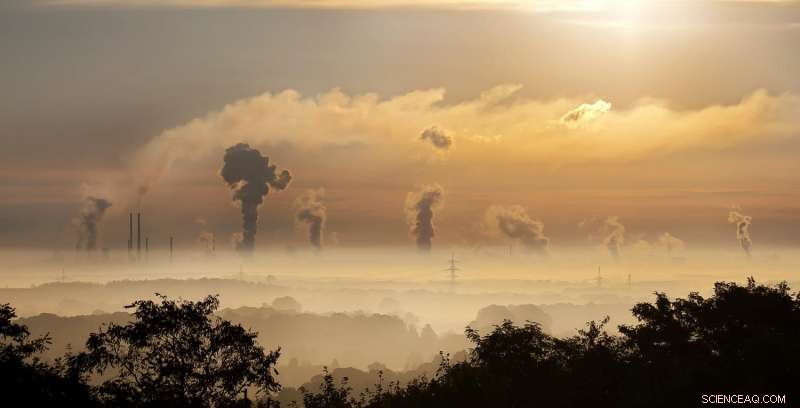
Black carbon consists of carbon particles that are small enough to become airborne. One such example is soot sent into the air from burning coal. It is not a greenhouse gas, but does contribute to global warming via another means. It lands on top of snow, and because it is black, absorbs heat from the sun, which causes two problems—one is that some of that in the northern latitudes, which would normally be reflected back into the atmosphere, remains on the ground. The other is that it contributes to higher than normal snow melt. In this new effort, the research team ventured into a remote part of Siberia to gather statistics on black carbon levels, because it is one of the few northern places left on Earth where data regarding its presence is not regularly collected.
The team set up a research station just outside of the town of Tiksi and immediately began monitoring the amount of black carbon that landed on its sensors. They report that they found more than was expected and that it was coming from an unexpected source. The biggest source, they found, was automobile exhaust, which was surprising because there is very little automobile traffic in Siberia. They suggest it likely traveled from more populous places in Europe, Russia and China. Before arriving at the site, the researchers had suspected that the biggest source would be gas flares caused by the oil industry, which are common in Siberia.
The researchers were able to identify the source of the black carbon by looking at its isotopic fingerprint—different sources produce different isotopes. Regular black soot, for example, has very little carbon 14. Such testing revealed that coal burning was the second largest source of black carbon in the region, though they noted things changed by season—during the summer, burning biomass was the biggest source.
The researchers suggest that it is important that all sources of climate change be accounted for if accurate predictions and models are to be made—a critical factor for figuring out how to reverse what is occurring.
© 2017 Phys.org