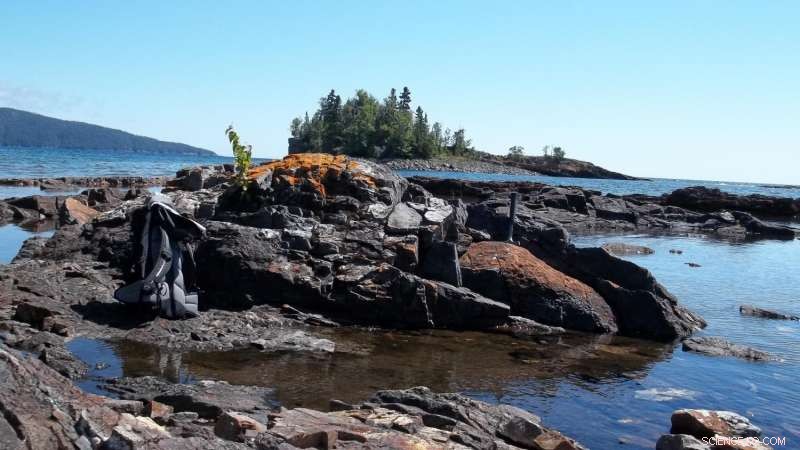
This is a 1.9-billion-year-old stromatolite — or mound made by microbes that lived in shallow water — called the Gunflint Formation in northern Minnesota. The environment of the oxygen “overshoot” described in research by Michael Kipp, Eva Stüeken and Roger Buick may have included this sort of oxygen-rich setting that is suitable for complex life. Credit: Eva Stüeken
(Phys.org)—A small team of researchers in the U.S. has found evidence in rock samples that suggests that oxygen levels during the Lomagundi Event were high enough to support the advancement of life on Earth. In their paper published in Proceedings of the National Academy of Sciences, the team describes how they analyzed rocks that had formed during the event period and in so doing found evidence of higher than expected oxygen levels.
Scientists believe that life first emerged on planet Earth almost 4 billion years ago—but it took almost another 3 billion years for eukaryotes (a cell-based organism with genetic material) to come about. But there is also evidence that the Earth experienced a time when oxygen levels rose, called the Lomagundi Event—it occurred approximately 2.3 to 2.1 billion years ago. Scientists would like to know whether the degree of oxygen enrichment during that time period was enough to support higher life form development, and if so, why eukaryotes didn't arise during that time instead of a billion years later.
To find out how much oxygen was in the atmosphere during the Lomagundi Event, the researchers collected rocks that had formed on the ocean floor during this period and ran tests that showed how much selenium they contained—it is released when rocks on land erode in the presence of oxygen and are carried to the sea by rivers, where selenium builds up in sea bottom rocks. Once on the sea bottom (in shallow areas), two selenium isotopes, 78 and 82 are metabolized by microbes and the ratios of each are determined by how much oxygen is in the water. Using all this information, the researchers were able to calculate that there would have been approximately 5 micromoles per liter of oxygen in the water during the Lomagundi Event—enough, they suggest, to support the development of life into something more complex.
To date, there has been little evidence that such a development occurred, but of course, as the researchers note, that doesn't mean it didn't happen. It is possible that life got a start then, was set back as atmospheric oxygen levels mysteriously dropped, and left behind little to show it had been there.
© 2017 Phys.org