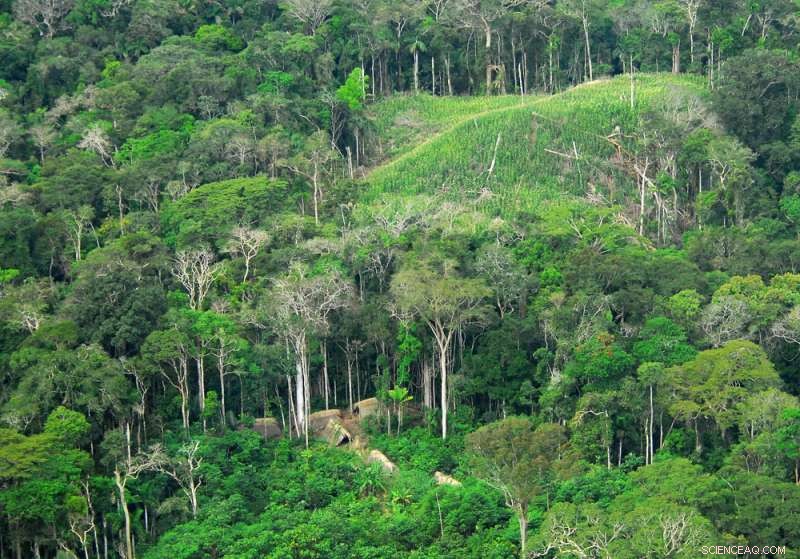
Uncontacted indigenous tribe in the brazilian state of Acre. Credit: Gleilson Miranda / Governo do Acre / Wikipedia
(Phys.org)—An international team of researchers has found evidence that suggests that Amazonia did not revert to savannah during the last ice age and instead remained forested. In their paper published in the journal Nature, the researchers describe how they retrieved stalagmite samples from a cave in one of the drier parts of Amazonia and used them to calculate not only how dry the area became during the last ice age, but what sorts of vegetation were growing. Mark Bush with the Florida Institute of Technology offers a News & Views piece in the same journal issue on the work done by the team and further explains how measuring the abundance of oxygen isotopes in stalagmites can reveal so much geological information.
Earth scientists have debated for many years how Amazonia fared during the Last Glacial Maximum (LGM)—some have speculated that it was likely the rainforests disappeared altogether due to less rainfall and was replaced by savannah. Others have countered that it was possible the forests remained throughout the LGM due to other difficult to discern factors. In this new effort, the researchers claim to have found evidence that supports the latter view.
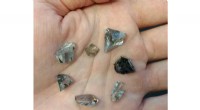
To learn more about the conditions present during the LGM, the researchers ventured to Paraíso Cave, located in what has been described as the dry corridor in the Amazonian lowlands, due to the area receiving less rainfall than other parts of the rain forest. In the cave, they located and removed seven stalagmites which they brought back to their lab for study. By studying the oxygen isotopes in them, the researchers were able to see that rainfall in the area (which percolated through the ground into the cave) was approximately half (42 percent) that seen today and that the local landscape remained heavily forested.
The researchers suggest that the reason the forests remained was lower temperatures in the area, which reduced evaporation, offsetting the loss of rainfall. Bush notes that data presented by the researchers studying the stalagmites is consistent with data from a prior study that examined lake sediments in the area. He also notes that it appears likely that fire in the area during the LGM was rare because it has been known to transform wet forests into savannah.
© 2017 Phys.org