Here's why:
* Wave nature of light: Waves can transfer energy continuously. Think of how ocean waves gradually transfer energy to a boat.
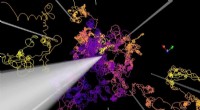
* Particle nature of light (photons): Light can be thought of as tiny packets of energy called photons. These photons interact with matter in a quantized way, meaning they can only transfer energy in discrete amounts.
The photoelectric effect:
This effect demonstrates the particle nature of light:
1. Shining light on a metal: When light shines on a metal surface, electrons can be ejected from the metal.
2. Frequency matters: The number of electrons ejected (and their energy) depends on the frequency of the light, not its intensity.
3. Threshold frequency: There's a minimum frequency (threshold frequency) below which no electrons are ejected, no matter how intense the light.
Why this supports the particle nature:
* Wave explanation fails: If light were purely a wave, increasing the intensity (amplitude) of the light should give the electrons more energy, leading to ejection even below the threshold frequency. This doesn't happen.
* Photon explanation succeeds: The photon model explains the photoelectric effect. A photon's energy is proportional to its frequency. If the photon's energy (determined by its frequency) is greater than the work function of the metal (the minimum energy needed to eject an electron), an electron is ejected.
In summary: The photoelectric effect demonstrates that light can behave as particles (photons) and the energy transfer is quantized, which cannot be explained by the wave nature of light alone.