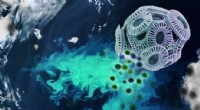
The Golden Ratio, often represented by the Greek letter phi (φ), is a mathematical rule that describes a pattern frequently observed in nature. It's approximately equal to 1.618 and is found in the arrangement of leaves on a stem, the spiral patterns of seashells, the proportions of the human body, and even the structure of galaxies.
The Rule:
The Golden Ratio is defined as the ratio of two quantities where the sum of those quantities divided by the larger quantity equals the larger quantity divided by the smaller quantity.
Formula:
* (a + b) / a = a / b = φ ≈ 1.618
Examples in Nature:
* Phyllotaxis (Leaf Arrangement): The arrangement of leaves on a stem often follows a Fibonacci sequence (1, 1, 2, 3, 5, 8, 13...), which is closely related to the Golden Ratio. This arrangement allows leaves to maximize sunlight exposure.
* Seashells: The spiral patterns of seashells, like the nautilus, often adhere to the Golden Ratio.
* Human Body: The proportions of the human body, like the ratio of the length of the forearm to the length of the hand, often approximate the Golden Ratio.
* Galaxies: The spiral arms of galaxies often exhibit patterns related to the Golden Ratio.
Why is it so prevalent?
The prevalence of the Golden Ratio in nature is often attributed to its efficiency and elegance. This mathematical relationship optimizes growth, space utilization, and aesthetic balance.
Beyond Nature:
The Golden Ratio also appears in art, architecture, and design, influencing aesthetics and proportions. It's believed to create a sense of visual harmony and pleasing proportions.
The Golden Ratio is a fascinating example of how mathematical rules can describe and explain patterns in the natural world, highlighting the interconnectedness of math, science, and art.