1. Dust and Gas Collapse:
* The solar nebula, mostly hydrogen and helium, starts collapsing, forming a rotating disk.
* As the disk spins, the materials clump together due to gravity, forming planetesimals.
2. Planetesimal Accretion:
* Planetesimals collide and stick together, growing larger and larger.
* Over millions of years, these collisions create larger bodies called protoplanets.
3. Earth Formation:
* Our protoplanet, Earth, continues to grow through collisions and accretion.
* The impact of a Mars-sized object, called Theia, creates the Moon.
4. Early Earth:
* Early Earth was incredibly hot and molten due to gravitational energy and radioactive decay.
* A dense atmosphere formed, composed of gases like hydrogen, helium, methane, and ammonia.
* Eventually, Earth cooled enough for a solid crust to form.
5. Differentiation:
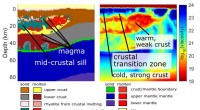
* The Earth's interior heated up, causing heavier elements like iron and nickel to sink to the core, forming the Earth's core.
* Lighter elements like silicon and oxygen rose to the surface, forming the mantle and crust.
6. Early Oceans and Atmosphere:
* As Earth cooled, water vapor condensed, forming the first oceans.
* Volcanic activity released gases, changing the atmosphere and paving the way for life.
7. Life Emerges:
* While the exact origin of life is still debated, it's believed to have emerged from simple organic molecules in the early oceans, forming the first single-celled organisms.
8. Evolution and Development:
* Over billions of years, life diversified and evolved, leading to the complex ecosystems we see today.
* Continents formed and drifted, shaping the Earth's surface.
* Climate changed dramatically, impacting life on Earth.
Important Note: This is a simplified explanation. The Earth's formation is a complex process, and scientists are still learning about it.