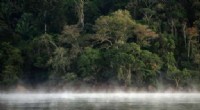
* Limited sunlight: The dense canopy of trees blocks out a significant amount of sunlight, reaching only about 1% of the sunlight that hits the top of the rainforest. This limits the amount of energy available for plants to perform photosynthesis.
* Competition from other plants: The forest floor is often crowded with plants like ferns, mosses, and seedlings that compete for the limited sunlight. This further restricts the amount of energy available for photosynthesis.
* Decomposition: The rainforest floor is covered in a thick layer of decaying organic matter. This decomposition process consumes oxygen, creating an environment that is less suitable for photosynthesis.
* Nutrient availability: While the rainforest is rich in nutrients overall, the soil on the forest floor is often nutrient-poor. This is because nutrients are quickly absorbed by the dense vegetation above and decomposition releases nutrients slowly.
These factors combine to create a challenging environment for plants to thrive on the rainforest floor. While some plants are adapted to these conditions, photosynthesis is generally limited, leading to a lower rate compared to the upper canopy.