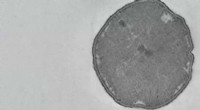
1. Viruses:
* Arguments for: Viruses are incredibly small and simple, consisting of genetic material (DNA or RNA) encased in a protein coat. They lack the ability to reproduce on their own and require a host cell to replicate.
* Arguments against: Viruses are not considered truly "living" by some scientists because they lack the complex machinery needed for independent life.
2. Mycoplasmas:
* Arguments for: Mycoplasmas are the smallest and simplest known self-replicating organisms. They are bacteria that lack a cell wall and have a relatively small genome.
* Arguments against: While small and simple, they are still considered complex compared to viruses, as they have a complete set of cellular machinery for independent life.
Ultimately, the "simplest" living thing depends on your definition of "living" and "simple." Both viruses and mycoplasmas are fascinating examples of minimalist life forms, pushing the boundaries of what we consider alive.