Here's a breakdown of the key components:
1. Unequal Heating:
* The equator receives more direct sunlight than the poles, causing it to be warmer.
* This difference in temperature creates a pressure gradient – high pressure at the poles and low pressure at the equator.
* Air naturally flows from areas of high pressure to low pressure, creating winds.
2. Earth's Rotation:
* The Earth's rotation influences the direction of the wind due to the Coriolis effect.
* This effect deflects moving objects (like air) to the right in the Northern Hemisphere and to the left in the Southern Hemisphere.
3. Major Wind Belts:
These are the primary wind patterns created by the interplay of unequal heating and the Coriolis effect:
* Trade Winds: Blow from the northeast (Northern Hemisphere) and southeast (Southern Hemisphere) towards the equator.
* Westerlies: Blow from the southwest (Northern Hemisphere) and northwest (Southern Hemisphere) towards the poles.
* Polar Easterlies: Blow from the east towards the poles.
4. Hadley Cells:
* These are the major atmospheric circulation cells that occur between the equator and about 30 degrees latitude in both hemispheres.
* Air rises at the equator, cools, and then descends at about 30 degrees latitude.
* This creates areas of high pressure at about 30 degrees and low pressure at the equator.
5. Ferrel Cells and Polar Cells:
* These are additional atmospheric circulation cells that contribute to the global wind system.
* Ferrel cells exist between 30 degrees and 60 degrees latitude, while polar cells exist beyond 60 degrees.
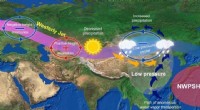
6. Jet Streams:
* These are fast-flowing, narrow air currents in the upper atmosphere.
* They are located at the boundaries between different atmospheric cells and play a role in steering weather systems.
Impact of the Global Wind System:
* Climate: The global wind system influences the distribution of heat and moisture around the globe, creating different climate zones.
* Weather: It helps move weather systems, influencing the frequency and severity of storms.
* Ocean Currents: Winds drive ocean currents, which play a crucial role in regulating global temperatures.
* Transportation: Winds have been used for centuries for sailing and air travel.
Understanding the global wind system is crucial for understanding global climate patterns, weather forecasting, and a variety of other environmental and societal issues.