Here's a breakdown:
* Aquatic succession is the gradual process of change in an aquatic ecosystem over time. It starts with a body of water like a pond or lake, and progresses through various stages.
* Early stages: The water is typically clear, with minimal plant life. Over time, organic matter accumulates, leading to increased plant growth.
* Mid-stages: The ecosystem becomes richer in plant and animal diversity.
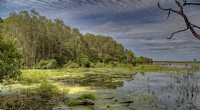
* Final stage (Climax community): The lake or pond eventually fills in completely, transforming into a terrestrial ecosystem like a forest or meadow. This climax community is characterized by:
* Dominant trees or vegetation specific to the local climate.
* A balanced ecosystem with diverse plant and animal life.
* A stable and self-sustaining environment.
Key points to remember:
* The specific climax community depends on the geographic location and environmental factors.
* Aquatic succession can take hundreds or even thousands of years.
* Human activities can influence the rate and outcome of succession.
Example:
A shallow lake, over time, may undergo succession as follows:
1. Open water: Abundant algae and phytoplankton.
2. Emergent vegetation: Cattails, reeds, and water lilies begin to grow.
3. Marsh: The lake gradually fills in with sediment, and the marsh expands.
4. Woodland: Trees like willows and cottonwoods establish themselves, eventually forming a mature forest.
Note: The process is not always linear and can be influenced by factors like rainfall, temperature, and nutrient availability.