What would you need to explore an ocean on Europa, one of Jupiter's moons? It's hundreds of millions of miles away, and the ocean lies under a sheet of ice at least 10 kilometers (6 miles) thick. You'd probably need a spacecraft to land on the ice, a way to drill through the ice, and a submersible vehicle to explore the ocean and relate findings back to Earth.
This submersible vehicle is a project occupying the efforts of Dr. Bill Stone, CEO of Stone Aerospace in Austin, Texas. Stone and his colleagues have developed a prototype autonomous underwater vehicle (AUV) called Deep Phreatic Thermal Explorer (DEPTHX) for remote exploration and are currently testing it in a large underwater cave. In this article, we will examine this revolutionary AUV, its mission and how it fits into the larger scheme of extraterrestrial exploration.
The DEPTHX project is one of a series funded by NASA to develop robotic probes capable of exploring Europa (we will discuss why Europa is such an interesting target later). Stone Aerospace designed, built and operates DEPTHX in cooperation with its partners:
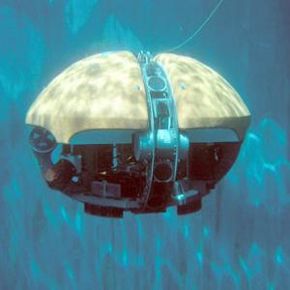
 DEPTHX on deck during one if its tests
Photo © Stone Aerospace/PSC, Inc.
DEPTHX on deck during one if its tests
Photo © Stone Aerospace/PSC, Inc.
The DEPTHX project is designed to answer these questions:
DEPTH X has completed tank testing (which includes systems integration and mapping) and is now preparing to undergo tests in a completely unknown environment: Mexico's Zacatón cenote.
Next, let's take a closer look at the AUV and its systems.
Cenotes
Cenotes (pronounced "say-NO-tay") are large freshwater sinkholes found in Mexico's Yucután Peninsula. These cenotes formed when underground water etched into the porous limestone bedrock that makes up the entire peninsula. The cenote in Zacáton is one of five connected cenotes and is thought to be the deepest in the world. Zacáton also has a hydrothermal spring inside it.
 DEPTHX internal structures
Image © Stone Aerospace/PSC, Inc.
DEPTHX internal structures
Image © Stone Aerospace/PSC, Inc.
The DEPTHX AUV is egg-shaped, with a long axis of 4.26 meters (13.97 feet), a short axis of 3.04 m (9.97 ft), and a weight of 1.3 metric tons (1.43 short tons). It can move freely, hover and wall track in three dimensions without any external commands. DEPTHX has a minimum cruising speed of 0.2 meters per second (0.65 feet per second) for mapping and can go as deep as 1,000 m (3,280 ft). To operate autonomously, DEPTHX must be able to do the following:
 A close-up of a DEPTHX thruster
Image © Stone Aerospace/PSC, Inc.
A close-up of a DEPTHX thruster
Image © Stone Aerospace/PSC, Inc.
DEPTHX has six thrusters (four horizontal and two vertical), which allow it to maneuver in three dimensions. The vehicle can be maneuvered with just two of the horizontal and one of the vertical thrusters -- the extras are for backup.
DEPTHX can also hover. To hold its position, it could use the thrusters, but this would rapidly consume valuable battery power. Instead, the vehicle is equipped with two variable-buoyancy engines (VBE). A VBE computer senses the pressure, temperature and salinity (salt content) of the surrounding water and calculates the craft's buoyancy. The computer then opens or closes valves that allow pumps or pressurized gas to let water in or out. As with the thrusters, there is built-in redundancy and the DEPTHX can hover using just one VBE.
 Variable-buoyancy engines allow DEPTHX to hover.
Image © Stone Aerospace/PSC, Inc.
Variable-buoyancy engines allow DEPTHX to hover.
Image © Stone Aerospace/PSC, Inc.
 Geometrical array of DEPTHX’s sonar sensor ability
Image © Stone Aerospace/PSC, Inc.
Geometrical array of DEPTHX’s sonar sensor ability
Image © Stone Aerospace/PSC, Inc.
DEPTHX has 54 sonar sensors spaced around its frame and controlled by two sonar arrays. The sonar uses pulses of high-energy sound waves and their reflections to locate objects within a 250- to 300-meter radius of the vehicle. The information it collects is relayed to on-board computers for navigation control.
In addition to sonar, DEPTHX navigates using accelerometers, depth gauges and an inertial guidance unit. A Doppler velocity logger determines how fast the vehicle is moving and feeds this information to the primary computer, which adjusts the vehicle's speed.
As DEPTHX moves, the computers use the sonar information to build up 3-D images, which are overlaid in the computer memory to make a progressive geometrical map. The technique is called Simultaneous Localization and Mapping (SLAM). Bill Stone and his colleagues developed a diver-propelled SLAM device that they used to map the Wakulla Springs aquifer in Florida. DEPTHX uses its internalized map for navigation so that it can move to any specific location without the assistance of external navigation, such as GPS.
 Map of a portion of Wakulla Springs aquifer obtained by Stone Aerospace
Image © Stone Aerospace/PSC, Inc.
Map of a portion of Wakulla Springs aquifer obtained by Stone Aerospace
Image © Stone Aerospace/PSC, Inc.
DEPTHX has several onboard computers dedicated to specific tasks. One controls vehicle operations, SLAM and navigation; one controls the VBEs; and one controls experiments and analyzes data. In total, these computers contain more than 30 microprocessors, from 8-bit controllers to Pentium 4 chips. DEPTHX is programmed for autonomous functioning and analysis.
DEPTHX has two battery towers comprising rechargeable lithium-ion batteries. The batteries provide up to eight hours of power.
 The DEPTHX AUV underwater
Image © Stone Aerospace/PSC, Inc.
The DEPTHX AUV underwater
Image © Stone Aerospace/PSC, Inc.
It can communicate by WiFi on the surface and by a single optical fiber cable while submerged. The cable is used to upload data or receive control commands when necessary.
DEPTHX will use its SLAM technologies to map and image as it explores. It has a wide-field imaging camera and will also be able to make environmental measurements such as temperature, pressure and concentrations of various chemicals. It also an extendable arm with a science probe that will allow it to collect both liquid and solid samples and a pressure-rated microscope onboard to aid in the detection of microbial life.
 Europa's ice rafts are blocks of ice that show that Europa may have had a subsurface ocean in its past.
Image courtesy NASA Jet Propulsion Laboratory
Europa's ice rafts are blocks of ice that show that Europa may have had a subsurface ocean in its past.
Image courtesy NASA Jet Propulsion LaboratorySo, why is Europa, an inner moon of Jupiter, such an interesting target for exploration? The Voyager and Galileo space probes showed that Europa was covered with an ice sheet. Because Europa is so close to Jupiter, the planet's gravity tugs on it, alternately stretching and compressing the moon in its orbit. These gravitational forces create heat within the moon. This heat escapes through volcanic activity and could warm the underside of the ice sheet, creating a liquid ocean.
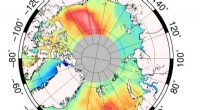
Evidence for a liquid ocean exists in the fractured pattern of the ice sheet, which is 10 kilometers (6.21 miles) thick. Similar patterns can be seen in the Arctic ice sheet as viewed by satellites from Earth orbit. Measurements of the magnetic field indicate that the prospective ocean might be salty. Also, calculations indicate that there is a sufficient amount of heat generated by tidal forces to make a liquid ocean.
 Hydrothermal vent in the ocean floor
Image courtesy NOAA/ U.S. Dept. of Commerce
Hydrothermal vent in the ocean floor
Image courtesy NOAA/ U.S. Dept. of Commerce
If a liquid ocean exists and volcanic activity from tidal forces exist, then there may be hydrothermal vents on the "ocean" floor, like those found on Earth near mid-ocean ridges.
On Earth, we know that many diverse life forms survive around hydrothermal vents in communities that are based on chemosynthesis, the formation of organic compounds using geothermal energy. Chemosynthetic bacteria form the basis of the food chain in these communities. Other organisms within these communities include giant tubeworms, clams, crabs and fish.
Astrobiologists believe that life needs liquid water, carbon-containing (organic) compounds, and a source of energy. Europa appears to have these ingredients as well and, therefore, could have life.
So a mission to Europa would include an AUV that could explore the ocean, carry out scientific experiments and relay results back to Earth.
Aerospace plans to build a subsequent vehicle called ENDURANCE, which will go one step further. It will be smaller, but just as capable as DEPTHX. ENDURANCE's test will be to explore a lake in Antarctica that is submerged beneath the ice sheet. NASA is currently developing the technology to melt through kilometers of ice into the lake. ENDURANCE will be lowered through the melt-hole into the lake for exploration using scientific principles and technologies, developed and tested by DEPTHX.
For lots more information on DEPTHX and related topics, check out the links on the next page.
Sources