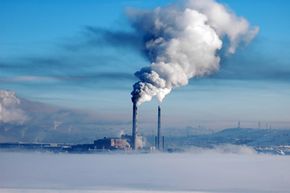
The dramatic imagery of global warming frightens people. Melting glaciers, freak storms and stranded polar bears -- the mascots of climate change -- show how quickly and drastically greenhouse gas emissions (GHG) are changing our planet. Such graphic examples, combined with the rising price of energy, drive people to want to reduce consumption and lower their personal shares of global emissions. But behind the emotional front of climate change lies a developing framework of economic solutions to the problem. Two major market-based options exist, and politicians around the world have largely settled on carbon trading over its rival, carbon tax, as the chosen method to regulate GHG emissions.
Renewing the Grid Image Gallery
Carbon trading, sometimes called emissions trading, is a market-based tool to limit GHG. The carbon market trades emissions under cap-and-trade schemes or with credits that pay for or offset GHG reductions.
Cap-and-trade schemes are the most popular way to regulate carbon dioxide (CO2) and other emissions. The scheme's governing body begins by setting a cap on allowable emissions. It then distributes or auctions off emissions allowances that total the cap. Member firms that do not have enough allowances to cover their emissions must either make reductions or buy another firm's spare credits. Members with extra allowances can sell them or bank them for future use. Cap-and-trade schemes can be either mandatory or voluntary.
A successful cap-and-trade scheme relies on a strict but feasible cap that decreases emissions over time. If the cap is set too high, an excess of emissions will enter the atmosphere and the scheme will have no effect on the environment. A high cap can also drive down the value of allowances, causing losses in firms that have reduced their emissions and banked credits. If the cap is set too low, allowances are scarce and overpriced. Some cap and trade schemes have safety valves to keep the value of allowances within a certain range. If the price of allowances gets too high, the scheme's governing body will release additional credits to stabilize the price. The price of allowances is usually a function of supply and demand.
Credits are similar to carbon offsets except that they're often used in conjunction with cap-and-trade schemes. Firms that wish to reduce below target may fund preapproved emissions reduction projects at other sites or even in other countries.
 U.N. Secretary-General Kofi Annanmarking the Kyoto Protocol's entryinto force in February 2005.AP Photo/Itsuo Inouye
The Kyoto Protocol, an international treaty on climate change that came into force in 2005, dominates the mandatory carbon market. It serves as both a model and a warning for every emerging carbon program.
In the early 1990s, nearly every member state of the United Nations resolved to confront global warming and manage its consequences. Although the resulting United Nations Framework Convention on Climate Change (UNFCCC) international treaty recognized a unified resolve to slow global warming, it set only loose goals for lowering emissions. In 1997, the Kyoto amendment strengthened the convention.
Under the Protocol, members of the convention with industrialized or transitional economies (Annex I members) receive specific reduction targets. Member states with developing economies are not expected to meet emissions targets -- an exception that has caused controversy because some nations like China and India produce enormous levels of GHG. The Protocol commits Annex I members to cut their emissions 5 percent below 1990 levels between 2008 and 2012. But because the Protocol does not manage the way in which members reduce their emissions, several mechanisms have arisen. The largest and most famous is the European Trading Scheme (ETS), still in its two-year trial phase.
The ETS is mandatory across the European Union (EU). The multisector cap and trade scheme includes about 12,000 factories and utilities in 25 countries [source: Europa]. Each member state sets its own emissions cap, or national allocation plan, based on its Kyoto and national targets. Countries then distribute allowances totaling the cap to individual firms. Even though countries distribute their own allowances, the allowances themselves can be traded across the EU. Independent third parties verify all emissions and reductions.
There has been, however, some question as to whether the ETS has actually helped reduce emissions. Some people even call it a "permit to pollute" because the ETS allows member states to distribute allowances free of charge [source: BBC News]. The ETS also excludes transport, homes and public sector emissions from regulation. And as with all cap-and-trade schemes, governments can essentially exempt influential industries by flooding them with free allowances.
The ETS allows its members to earn credits by funding projects through two other Kyoto mechanisms: the Clean Development Mechanism (CDM) and Joint Implementation (JI). CDM allows Annex I industrialized countries to pay for emissions reduction projects in poorer countries that do not have emissions targets. By funding projects, Annex I countries earn certified emissions reduction (CER) credits to add to their own allowances. JI allows Annex I parties to fund projects in other Annex I countries.
The Kyoto Protocol expires in 2012. Lawmakers around the world are rushing to analyze its achievements and shortcomings and negotiate a successor. The United States, Kyoto's most famous holdout, lacks any national mandatory carbon legislation but, ironically, has a booming voluntary carbon market. In the next section we'll learn about the Chicago Climate Exchange.
 Dr. Richard Sandor (center), chairman and CEO of the CCX, speaks with U.S. Secretary of Energy Spencer Abraham (left) and Chicago Mayor Richard Daley after the CCX’s first allowance auction in 2003.
Scott Olson/AFP/Getty Images
Dr. Richard Sandor (center), chairman and CEO of the CCX, speaks with U.S. Secretary of Energy Spencer Abraham (left) and Chicago Mayor Richard Daley after the CCX’s first allowance auction in 2003.
Scott Olson/AFP/Getty ImagesThe Clinton administration helped develop the Kyoto Protocol. But when it came time to ratify the treaty in 2001, the United States chose not to. The government believed that Kyoto was fatally flawed and could cause economic havoc [source: Washington Post]. Not all Americans agreed, however. In 2005, 132 of the nation's mayors pledged to meet Kyoto-like emissions targets. Many cited the economic consequences of dwindling water supplies and rising oceans.
Some cities and companies took action even earlier. In 2003, Dr. Richard Sandor founded the Chicago Climate Exchange (CCX), a voluntary carbon market. Members of the CCX willingly join the pooled commodity but commit to legally binding reductions. Since the CCX is voluntary, all sorts of organizations have joined: companies, universities and even cities. Michigan State, Ford, DuPont and the cities of Chicago and Portland, Ore., are among its members.
Like other cap-and-trade programs, the CCX sets a limit on total allowable emissions and issues allowances that equal the cap. Member firms then trade the allowances -- carbon financial instruments (CFIs) -- amongst themselves. Each CFI equals 100 metric tons of CO2 equivalent. Members that meet their targets can sell or bank their allowances. Firms can also generate CFIs, specifically exchange offsets, by funding approved GHG reduction projects outside of the pool. In 2006, CCX traded a total of 10.2 million tons of CO2 [Climate Exchange, Plc]. Because CCX is owned by an independent, publicly traded company, it's free from the federal regulations that can bog down mandatory carbon trading schemes.
Like Kyoto or the ETS, the CCX has two phases of implementation. In the first phase, which ran from 2003 to 2006, members committed to reducing emissions by only 1 percent per year below their baselines. In the second phase, which will run from 2007 to 2010, members will reduce emissions 6 percent below their baselines.
Although the CCX's high cap has drawn criticism, the pooled commodity's true benefit may end up being the market-based practice it provides its members. Cities across the country have already created municipal carbon schemes. Some states are fashioning mandatory carbon markets for utilities. The United States is very likely headed toward some form of national carbon legislation. When such a time comes, members of the CCX will have the valuable advantage of experience.
Carbon trading and other market-based schemes add a needed dose of economic practicality to the emotionally charged issue of global warming. They help change the way we think about emissions, energy efficiency and the environment.
To learn more about carbon trading, carbon offsets and global warming, check out the links on the next page.
Make It RainThe United States has actually had a national cap-and-trade scheme for years -- it's just not a cap on carbon. The Acid Rain Program limits the amount of sulfur dioxide (SO2) that power plants in the contiguous United States can produce. Plants can reduce their emissions and trade the allowances. The program has worked: it has a high rate of compliance, and power plant emissions have dropped 50 percent below what they were in 1980. The final 2010 cap will be 8.95 million tons allowed per year [source: EPA].
Sources