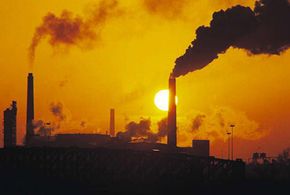
Global warming has become an accepted part of our future. Its impacts may be as serious as widespread ecological disaster, species extinction and famine. One of the greenhouse gases contributing to the warming of the planet is carbon dioxide (CO2). The biggest CO2 emitters are power plants, which, according to for-profit environmentally concerned Skyonic Corporation, release more than 2.3 billion metric tons of the stuff every year in the United States alone (our cars emit a mere 1.9 billion) [source: Skyonic]. So what's Skyonic going to do about it? It's going to produce baking soda.
Lots of green-minded individuals and companies are coming up with inventive approaches to carbon capture and sequestration -- basically, removing CO2 from industrial exhaust and then storing it somewhere it won't contribute to global warming. Some methods take CO2 gas out of power plant exhaust, compress it into liquid form, and then pipe it into an underground storage system. It's a workable concept. But it's also very expensive, and storing the carbon dioxide in liquid form makes some scientists nervous: Liquids have a tendency to leak.
Skyonic's SkyMine technology takes a different approach. It's not cheap, but it's potentially less risky -- and less damaging to industry profitability in the long run, which means it might be more palatable to power companies. It's currently one of the only systems that would produce sellable byproducts from the captured CO2. Plus, it could substantially increase our ability to absorb refrigerator odors.
So how do you get baking soda out of pollutants? It's amazingly simple. On the next page, we'll look at the chemistry behind SkyMine.
What's it good for?*Most of us know that baking soda absorbs odors and is essential to a good loaf of banana bread. But you may not know that baking soda:
*These tips are provided for informational purposes only. They'll probably work. They might not.
Read More Baking soda made from industrial emissions could be sequestered safely and easily.
Picturegarden/The Image Bank/Getty Images
Baking soda made from industrial emissions could be sequestered safely and easily.
Picturegarden/The Image Bank/Getty ImagesSkyonic's capture-and-sequester approach goes something like this:
It's a very cool concept, even in its simplest form. If we look deeper, it gets even more interesting. A coal-burning power plant essentially produces three things: power (good), pollutants (bad) and heat (neutral). SkyMine uses everything we don't want or don't care about -- pollutants, waste and heat -- to create products people actually want.
The SkyMine device, which is the size of two 50-foot trailers in its prototype form, taps into the plant's flue. It directs the emissions into the trailers instead of into the air. The heat that flows out through the power plant's flue (sort of like a chimney) powers SkyMine. Burning coal produces enormous amounts of heat, so there's plenty of power to run the system. Once inside SkyMine, a series of steps changes pollutants into beneficial substances.
 The SkyMine Process
2008 HowStuffWorks
The SkyMine Process
2008 HowStuffWorks
This process is very effective: SkyMine removes between 85 percent and 97 percent of the mercury, acid rain gasses and CO2 from the flue gases that pass through the system. The reaction's main byproduct, sodium bicarbonate, is perfectly harmless and endlessly useful. But here's the thing: Even with the thousands of home and industrial uses for baking soda, there may not be enough buyers in the entire world for the amount of baking soda SkyMine would produce.
So how much baking soda are we talking about, and where's it going to go? Next, we'll look at the ups and downs of SkyMine.
 What would we do with all the baking soda produced by the SkyMine? It could be used in volcano science experiments.
Michelle Pedone/Photonica/Getty Images
What would we do with all the baking soda produced by the SkyMine? It could be used in volcano science experiments.
Michelle Pedone/Photonica/Getty ImagesA single large coal-, gas- or oil-fired power plant produces more than 300,000 tons of CO2 in a year. Pass that CO2 through SkyMine, and you've got yourself more than 600,000 tons of baking soda. And there are more than 10,000 of those power plants in
the United States [source: EIA].
Hydrogen and chlorine have major industrial markets -- domestic demand is at more than $70 billion combined (mostly for the hydrogen) [source: Skyonic]. But baking soda? That's cheap stuff. Even considering that SkyMine reportedly produces purer baking soda than what's currently on the shelves in grocery stores, and it's commonly used as an industrial abrasive, we're not even close to consuming what SkyMine can create.
This is where the crystalline benefit comes in. As opposed to liquids and gases, solids are a cinch to store. Baking soda is stable. Used as coal-mine filler or dumped in landfills, it's not going to pollute the soil or leak into the air. You don't even need to pipe it in; you can just load it into cargo transports and drop it into the desired location. Also, with all that carbon-capture baking soda on the market, baking soda companies can stop mining the stuff, which is an expensive process in itself.
With all of its upsides, the fact remains that SkyMine technology is a major initial investment. The device itself, once it's out of the prototype stage, will go for about $400 million U.S. That's about the cost of the scrubbers that power plants have already bought and currently use to remove mercury and smog chemicals from their exhaust streams. But Skyonic points out that SkyMine will be able to replace these scrubbers, eliminating tens of millions of dollars of annual scrubber operating costs each year along with any federal or state carbon taxes. SkyMine could maybe even help the power plant turn a profit with sales of hydrogen, chlorine and baking soda.
Far-fetched as it may seem to save the world with baking soda, SkyMine is not just a theory. Texas power giant Luminant has already signed on, conducting trials with a prototype SkyMine since early 2007. According to Steve Guengerich of AustinStartup's CleanTech Friday, SkyMine currently looks like a couple of trailer homes with a pipe coming out of them, and the device is mostly handmade [source: Austin Startup].
Skyonic expects to get out of trial stage and start selling much prettier SkyMines commercially by the end of 2010. If the energy industry gets on board, we could be looking at a greener, cleaner, better-smelling world to come. A world where coming up with new recipes that call for baking soda can earn you carbon credits. A world where eating cake is just the right thing to do.
For more information on global warming, green technology and lots of recipes that use baking soda, check out the links below.
Baking Soda UsesVisit these articles for more ideas on how to use and benefit from baking soda:
Baking Soda for Health/Beauty
Baking Soda in the Bathroom
Baking Soda in the Kitchen
Baking Soda for House Cleaning
Baking Soda for Clothing Care
Baking Soda Children's Activities
Read MoreSources