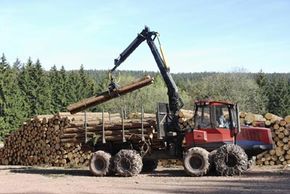
Wood has arguably been the most resourceful substance in human history. People have used wood for millennia because it's great for fueling fire, making tools, furniture and paper, and especially for construction. Unlike money, wood actually does grow on trees, which can make it seem ubiquitous and inexhaustible. Although wood is one of our most renewable resources, by the late 1900s, environmentalists were concerned with overuse of the earth's forests. The world's appetite for wood, wood products and forest land took a toll. Drastic deforestation threatened to deplete resources, damage forest wildlife and contribute to global warming.
As environmentalist groups gained supporters, certain forest management companies sought a way to demonstrate their commitment to well-managed harvesting. Various groups, including environmental groups and timber traders, worked together to find a way to evaluate forests and wood products for responsible, environmentally friendly management. In the early 1990s, these groups established the Forest Stewardship Council (FSC), an international organization dedicated to regulating and maintaining accreditation standards.
The FSC's main purpose is to provide a way for industry and consumers to know that wood and its byproducts come from responsibly managed forests and supply chains. The council maintains a set of principles and criteria to make sure that wood products don't destroy natural resources or threaten wildlife.
The council lays out the standard for two different certifications: Forest Management (FM) and Chain of Custody (CoC). FM certification is granted to a well-managed forest. On the other hand, CoC certification is granted to products that are appropriately manufactured and tracked from the forest to the consumer. With a CoC certification, companies that package and trade forest products can brand their products with the FSC logo. Consumers know that when they buy products with this logo, they're buying green goods.
Let's learn more about the FSC's standards for certification.
 The FSC principles not only set standards for companies to responsibly manage forests, but also to treat employees fairly.
Jochen Schoengart/FSC
The FSC principles not only set standards for companies to responsibly manage forests, but also to treat employees fairly.
Jochen Schoengart/FSC
One thing to remember about the FSC is that it merely forms standards. The organization doesn't issue certifications, but it accredits third-party agencies, which perform audits and grant certifications to qualified parties. At the time of this article, there are 12 certifying agencies around the world [source: FSC US].
The FSC has put together standards to evaluate forest management on environmental, social and economic issues. Certifying agencies use these principles and criteria to judge forest management and chain of custody procedures. For forest stewardship in general, the FSC's principles are as follows with a summary of their criteria:
The FSC's trademark representing Responsible Forest Management. Branding this on forest products lets consumers know they came from FSC-approved forests.
Forest Stewardship Council
Let's look at an example of the FM certification process: A farm management group voluntarily requests review for certification from the accredited agency. The agency performs an audit to check for significant failures to live up to the principles listed above. After a group earns certification, it gets an annual review. Every five years, it goes through the full renewal process again [source FSC US].
Organizations involved in packaging, changing, or trading the resulting wood or other forest products apply for a CoC certification [source: FSC]. These include mills, furniture makers, wholesalers and retailers [source: SCS]. Like an FM certification, CoC uses a third-party agency to determine who qualifies. This third party inspects the client's inventory system to trace the wood to an FSC-certified forest and evaluate its processing. As we mentioned earlier, companies that qualify for this certification can brand their products with the FSC logo so that consumers can be sure of its origin.
So what does this mean for the market? Do consumers prefer to buy FSC-certified wood? Read on to find out.
 One key to the FSC's success is customer preference for buying wood with the FSC logo.
B2M Productions/Digital Vision/Getty Images
One key to the FSC's success is customer preference for buying wood with the FSC logo.
B2M Productions/Digital Vision/Getty ImagesAlthough certification is done on a volunteer-basis, the FSC has significantly impacted the forest industry. By 2008, FSC certified forests spanned 100 million hectares (7 percent of the world's productive forests) in more than 79 countries [source: FSC]. At FSC's inception, many companies were already following FSC-type standards, and they quickly joined the council to prove their dedication to the cause. The success of the FSC's desirable logo encourages other companies to improve their sustainable management practices [source: Diamond].
So what does it take to get the rest of the forest industry on board? If FSC-endorsed products gain market share, it will create an economic incentive for the remaining retailers, wholesalers and suppliers to earn certification. As the green trend continues, more people buy products from companies that demonstrate dedication to responsible practices.
To illustrate market share and customer preference, let's look at tests performed in Home Depot stores in Oregon. This test set up bins of FSC-certified wood alongside unmarked wood showed that customers largely preferred the FSC product when both are the same price. When the FSC wood was 2 percent more expensive, 37 percent of customers still chose the FSC wood [source: Diamond]. This is especially significant considering the low profile that FSC has in the U.S. In some countries like the Netherlands, public service announcements have helped boost customer awareness and preference for FSC products. The increasingly environmentally-aware consumer has contributed to what FSC estimates is $20 billion worth of sales in certified products [source: FSC].
Much of FSC's success depends on whether retailers stock certified products. Home Depot, the world's largest retailer of timber, has announced a preference for FSC wood. Although the company wanted to exclusively sell FSC-certified wood, the supply isn't keeping up with the demand [source: Chiras]. Lowes, the second largest retailer of timber, and IKEA, the furniture company, have also shown support [source: Diamond, Clifford]. Momentum is picking up so that Home Depot and other stores are now pressuring their wood suppliers to seek FSC certification [source: Diamond].
Overall, the incentive for certification seems to be growing, which says something about the FSC's influence on forest products.
For more information on the FSC and other related topics, explore the great links on the next page.
Forest WarsAfter the FSC was launched, members of the timber and paper industries formed a competing certification group, the Sustainable Forestry Initiative (SFI). To meet what it considers more practical and cost-effective goals, the SFI's requirements are generally less stringent than the FSC's. For instance, it allows more tolerance for plantations, and it leaves labor issues up to U.S. law. Since its founding, the SFI has become independent of its founding organization, the American Forest and Paper Association. It's also added representatives from environmental groups to its board, which earned it some credibility from its critics [source Grewell].
Sources