Even if it's been years since the last time you set foot in a school, the term "science fair" probably conjures up a clear mental image. The competitive world of cardboard triptychs and the scientific method has become part of popular culture. It's played a part in everything from a Pulitzer prize-winning play to episodes of "The Cosby Show" and "Monk."
The Siemens We Can Change the World Challenge is like a science fair on a mission. Just like in an ordinary science fair, students research a subject, develop a hypothesis, test it and report on their findings. But there are no man-in-the-moon marigolds, rubber-ball models of the solar system or exceptionally long-lived pet fish in the Siemens We Can Change the World Challenge. Instead, this fair focuses on identifying and addressing environmental problems -- it's a science competition with a green theme.
The goal of the Siemens We Can Change the World Challenge is to do more than just give kids a chance to formulate an experiment and carry it out. Contestants explore an environmental problem that affects their community. As part of the challenge, students must also put together guidelines for how other communities could repeat the project, and they share those guidelines as part of the contest. The basic idea is to give lots of communities new tools for conservation and sustainability and give students a new way to study science at the same time.
Who can participate in the Siemens We Can Change the World Challenge, and how are the entries judged? Other than a slew of new conservation programs, what are the competition's rewards? Find out on the next few pages.
 Each project entered in the Siemens We Can Change the World Challenge has a green theme.
Kane Skennar/Digital Vision/Getty Images
Each project entered in the Siemens We Can Change the World Challenge has a green theme.
Kane Skennar/Digital Vision/Getty ImagesThe Siemens We Can Change the World Challenge is part of a five-year partnership involving the Siemens Foundation, Discovery Education and the National Science Teachers Association, along with other organizations. In 2008, its first year, the competition is open to middle-school students. In 2009, it will expand to involve elementary students, and in 2010, high-school students will be included as well. As students get older and move from grade to grade, the scope of the competition gets bigger while staying focused on environmental initiatives. These are the areas that the students will focus on as they progress through the different levels of the challenge:
Students from all 50 states and Washington, D.C., are eligible to enter, and they can attend public, private, parochial or home schools. But students don't enter alone -- to be part of the Siemens We Can Change the World Challenge, they must form teams of two or three members. They also must have the sponsorship of a teacher or other adult member. This adult will be the person who submits the final entry to the contest.
Once they've formed a team, the students embark on a project that challenges them to follow the adage, "think globally, act locally." Contestants must isolate a problem in their community that relates to the environment, sustainability, conservation or other "green" initiatives. It should be a problem that other communities in the Untied States encounter as well, and the solution should be something other communities can put into place effectively.
Just like a science fair project, the entry should rely on science and the scientific method. Contestants should:
And since the purpose of the Siemens We Can Change the World Challenge doesn't stop with reporting the results, contestants should also put together a plan for repeating the project. People in other locations will be able to use this plan to do the project themselves. In other words, contestants must first complete the project, then explain how others can do it, too.
The teacher or other adult mentor working with each team submits the team's entry online at the We Can Change the World Challenge Web site. Then, it's time for judging. Read on to learn about the judging process and awards for the Siemens We Can Change the World Challenge.
It's Not Just For the KidsThe Siemens We Can Change the World Challenge isn't just a fun way for students to learn about science. The program also offers educational materials that follow state curriculum guidelines for teachers to use.
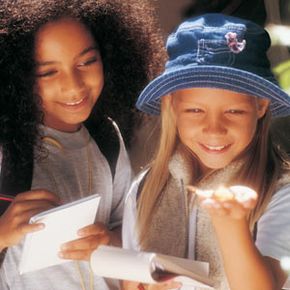
 Part of the Siemens We Can Change the World Challenge is sharing projects so others can do them.
Stephanie Rausser/Iconica/Getty Images
Part of the Siemens We Can Change the World Challenge is sharing projects so others can do them.
Stephanie Rausser/Iconica/Getty ImagesStudents create the projects for the Siemens We Can Change the World Challenge, but the judging is up to teachers and other professionals. These judges have a big job to do. First, they must narrow the pool of entries down to 51 state finalists -- one for each state of the United States and Washington, D.C. From there, judges select the top three teams. This process is based on scores in four areas:
All 51 state finalists gain recognition from the competition and a prize pack. The top three teams receive grant money to help them put their green plan into action. On top of that, each member of the top three teams receive additional awards:
The mentors who have worked with the winning teams get to go on the trips as well. Teachers who supervise the top three teams also win a Flip camera and free registration to the next national or area National Science Teachers Association conference. Mentors for the 51 state finalists receive a one-year subscription to Discovery Education Science and a one-year membership to the National Science Teachers Association.
Of course, since the Siemens We Can Change the World Challenge is founded on the idea of sharing knowledge about sustainability, all projects that follow the entry criteria are posted online for others to share. You can learn more about the Siemens We Can Change the World Challenge and other green initiatives on the next page.
The Siemens FoundationThe Siemens Foundation is one of the primary partners behind the Siemens We Can Change the World Challenge. The organization funds other science and technology initiatives as well. One is the Siemens Challenge, a math, science and technology competition for high-school students that awards scholarships to finalists and winners. It also funds scholarships to encourage minority students to become math and science teachers.
Sources