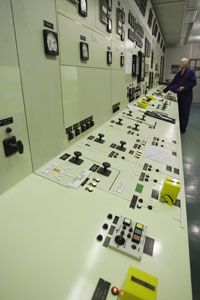
When you turn on an appliance, you expect immediate results: You don't wait for a light bulb to come on after you've flipped the switch. Electricity isn't stored in a tank in your yard, so when you need it now, how does it deliver? That's the power grid at work. Electricity is generated at a power plant and transmitted to local substations where transformers turn it into a usable voltage. Then it's distributed into our homes and businesses through a web of high voltage transmission lines -- the grid.
From day to day, electricity consumers use a predictable minimum amount of power, called the baseload. At the very least, the grid needs to handle this scheduled energy production, in addition to any usage spikes that happen. Demand for electricity is typically highest in the afternoon and early evening, as well as during the summertime when air conditioners run day and night. When many people want to use their electrical appliances at the same time it's called peak usage time.
Until your power is knocked out, you probably don't pay much attention to how often you turn on a light or the television or what time of day you do it. When you flip on a light switch, electricity travels in an instant to your home and the bulb glows -- that's called demand. When millions of electricity customers all turn on their air conditioners after work, it increases the demand load on the grid. Our demand for electricity is growing and the Energy Information Administration estimates that demand will rise at least 40 percent by 2030 [source: EEI].
The power grid supplies only the electricity we ask for, though, and it's up to us to practice energy conservation. One way to decrease the demand load is a concept called demand response. In broad terms, demand response programs give us -- residential, commercial and industrial consumers -- the ability to voluntarily trim our electricity usage at specific times of the day (such as peak hours) during high electricity prices, or during emergencies (such as preventing a blackout).
Let's look at the impact of demand response on the energy industry, the power grid and the environment.
Contents Refurbishing aging electrical infrastructure will help power companies keep up with demand.
Don Farrall/Stockbyte/Getty Images
Refurbishing aging electrical infrastructure will help power companies keep up with demand.
Don Farrall/Stockbyte/Getty ImagesAs it exists now, the energy industry faces a myriad of infrastructure issues. To keep up with the load demand and its expected rise, the industry needs to relieve the increased stress on the aging grid and build new power plants and transmission power lines while working to reduce greenhouse gas emissions and the skyrocketing costs of energy.
In 2003, the United States used 3,883 billion kWh -- with a population of 280 million people, that's the equivalent of 13,868 kWh used by each person [source: U.S. Department of Energy]. Of course, energy consumption is not spread equally from state to state. Larger states with many people will use more electricity than smaller states, or states with fewer people. Residents in Southern states might use more power to cool their homes and businesses in the summer than a state in the Pacific Northwest, where the climate is cooler.
Brownouts, rolling blackouts and blackouts, such as the one that hit the both Europe and the eastern United States and Canada in 2003, happen when the power supply is lost, usually caused by a malfunctioning electrical grid or component or by a supply-demand discrepancy. Blackouts aren't just inconvenient, they're also money pits. It's been estimated the 2003 blackout cost New York City alone up to $750 million in lost revenue [source: USA Today]. For businesses across the United States, power outages mean at least $50 billion in lost revenues annually [source: Samson].
The industry is looking at demand response programs, big and small, as an important piece to the infrastructure solution. Automatic direct response systems could sense imminent demand load problems and divert or reduce power in strategic places, removing the chance of overload and the resulting power failure. These programs also have the potential to help both the providers and consumers save money; they could eliminate the need to build additional power plants and delivery systems -- specifically, those for use during peak times only -- as well as the potential to lower wholesale energy costs.
The U.S. Department of Energy estimates the average home uses about 11,000 kilowatt-hours (kWh) annually. When you buy electricity, you're buying kilowatt-hours. One kilowatt-hour is equal to 1000 watts of electricity used in one hour.
On average, consumers spend 8.3 cents per kWh, so that adds up to each household spending about $900 on electricity every year [source: U.S. Department of Energy].
The rate you pay per kWh consumed is determined by a combination of factors, including regulations, fuel costs, weather (storms, extreme temperatures), time of day and consumer demand. While the rate determination is complicated, calculating your own home's daily cost of operation is not. And without automatic demand response systems in place, you're on your own to manually reduce your consumption.
Two residential-level ideas, dynamic pricing and time-of-use rates (TOU), work similarly to buying off-peak airline fares. If you want to fly during peak times, you pay more. If you want to use your dishwasher during peak times, you pay more. With dynamic pricing, consumers are offered rate discounts during normal usage periods and charged higher rates during peak times. Alternatively, TOU allows consumers to shift their usage patterns from high-price peak hours to less expensive off-peak hours by sharing information to make smart adjustments: A TOU meter at home tracks the total kWh energy usage over a period of time (day, year). You save money, and the grid saves power.
What about larger-scale demand response systems, something that doesn't leave the consumer to manually cut loads? In addition to residential efforts, there are companies emerging with the sole purpose of demand response. Companies called aggregators are stepping in to reduce grid loads by collect negawatts. A negawatt is a unit of power that is no longer needed, and aggregators sell them to regional Independent System Operators (ISOs) who use them to reduce the load on a specific part of the grid.
 If you lived in a smart house, you wouldn't have to turn down the thermostat to save energy -- the house would do it for you.
Jeffrey Hamilton/Stockbyte/Getty Images
If you lived in a smart house, you wouldn't have to turn down the thermostat to save energy -- the house would do it for you.
Jeffrey Hamilton/Stockbyte/Getty ImagesOne of the most exciting models of demand response is the smart grid and its connection to smart buildings.
A smart grid is the 21st century version of the current grid. Today's grid is one-way only: You turn on the television, and it brings the power. A smart grid would be a two-way communication system between provider and consumer. The structure of the grid is often described as similar to the Internet. In the same way every computer that accesses the Internet has an Internet address, the smart grid would have a web of access points that could be identified and contacted. Through these contact points, the grid would automate the flow of electricity as needed, identify and isolate load problems; it would also be able to handle uneven supplies of energy from renewable sources such as wind and solar power.
A smart grid talking to dumb terminals and appliances in a house can only accomplish so much. The grid may identify a load problem but without a smart building partner, it can do nothing but raise a red flag. Consumers are then told to reduce or turn off their energy usage.
When smart buildings are hooked up to a smart grid, the buildings respond to information received from the grid. Are electricity prices getting higher? The self-monitoring house automatically reacts by reducing the power usage -- maybe by turning down the thermostat or turning off the dishwasher. Consumers ultimately have the power to turn the heat back up a few degrees if they prefer a warmer house.
In a yearlong, small-scale study in homes on the Olympic Peninsula in Washington, the Department of Energy (DOE) found that when consumers were equipped with smart electric meters, thermostats, water heaters and dryers, they reduced their energy usage and associated costs -- on average, participants saved 10 percent on their electricity bills, and there was a 15 percent reduction in peak load usage [source: Grist].
Today's Smart Grid CitiesXcel Energy wants to turn Boulder, Colo., into the first smart grid city in the United States. The city would receive upgrades to its existing power infrastructure from a blind, metering grid to an electrical system capable of providing real-time, two-way communications throughout its new smart grid.
 A turbine at the Geysers power plant in California generates electricity from geothermal sources.
Kim Steele/The Image Bank/Getty Images
A turbine at the Geysers power plant in California generates electricity from geothermal sources.
Kim Steele/The Image Bank/Getty ImagesThe benefit of demand response isn't just in the economic cost savings, but also in environmental costs. While there is no definitive research yet on how demand response systems will -- or won't -- impact the environment, there are some positive effects that can be expected.
First, many field experts assume that if people are given a choice between conserving or not, they will choose to conserve because it's a feel-good, green contribution.
Beyond possible psychological effects, demand response brings about some very real environmental results. While demand response technology shifts power from one source to another, it also functions to lower the amount of power consumed. Less power consumed in turn lowers the levels of pollutants generated. Without demand response, systems used to heat and cool homes across the United States release 150 million tons of carbon dioxide (CO2), a known greenhouse gas, into the environment [source: U.S. Department of Energy], and about 30,000 Americans die every year from the pollution caused during electricity production [source: Solar Energy International].
With demand response, the 21st century smart grid could be a green grid. Plants that generate peak power often also generate high levels of pollutants. A smart grid is more easily capable of handling power sources that may be intermittent in intensity and may not always be on hand. When demand for power peaks, a smart grid would be able to shift the fuel type it uses, balancing fossil fuels and renewable energy sources.
Next time you're watching television, cooking dinner and doing a load of laundry, take a look at the clock. Is it peak time?
Google's Green GridGoogle, who has previously invested in geothermal power systems, recently announced they would partner with General Electric to investing in smart grid technology. Why? Google's data centers use a lot of electricity -- by implementing demand response technology via a smart grid, Google stands to save some money.
Writing about demand response meant more than learning about consumer energy demands -- it meant learning about the power grid, how the grid responds to consumer consumption and how it could respond if it were a bit smarter. The current power grid, it turns out, is not smart, nor is it big into communication. Demand response is a way for consumers to make smarter decisions about energy consumption, as well as for the grid to do the same. A smart grid could tell you that you're using your dishwasher at a peak energy usage time and if you wait a few hours there will be less demand. A smart grid could also be able to shift power from one source to another to avoid energy depletions that cause brownouts and blackouts. A smart grid could also be a green grid, balancing energy output from fossil fuel-driven power generators and renewable energy sources. Why haven't we implemented this?