It seems like every day we hear about a new technology that may provide the next generation of clean, green power. Whether it's algae, wind, biomass, geothermal or some improvement on an existing technology, supposed saviors are always around the corner. Into this fraught landscape, enter nano flakes -- a semiconductor nanostructure that may point the way for the next generation of solar-cell energy production.
Nano flakes are the work of Dr. Martin Aagesen, a researcher at the University of Copenhagen. In 2007, Aagesen claimed that he "discovered a perfect crystalline structure" that could allow the harvesting of 30 percent of solar energy directed at a surface [source: Science Daily].
Currently, solar panels, at best, are only able to convert about 15 to 20 percent of sunlight into energy [source: Science Daily]. That inefficiency contributes to the relatively high cost of solar energy production compared to other dirtier forms of energy like coal. More solar panels have to be used (and more silicon used in panel production and more real estate taken up by arrays of panels) to gather an equivalent amount of energy.
Aagesen founded a company called SunFlake to develop products based on his discovery. He promises that solar-cell efficiency will be boosted because energy will have shorter distances to travel within the cell and that his panels will be cheaper by using less silicon.
His nano flake technology distinguishes itself by its promises of greater efficiency but also by its structure. Silicon that is arranged in a pure crystalline structure normally doesn't conduct electricity well. That's why most silicon-based solar panels have impurities built in -- to allow electrons to move around and fill in gaps, creating an electric field. (For more details about the structure of a traditional solar panel, read How Solar Cells Work.)
But while Aagesen's discovery received a brief flurry of publicity in 2007, there are some skeptics. For one, the technology is very much in a prototype phase, and little has been heard of it since its initial announcement. As one commentator pointed out, Aagesen produced a highly efficient light collector -- not a fully functioning solar panel that converts light photons to moving electrons (in other words, to energy) [source: Westenhaus]. He still has a long way to go before creating a bleeding-edge, functioning solar array.
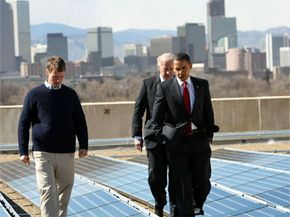
 An engineer holds a sheet of thin-film solar cells at the National Renewable Energy Laboratory in Golden, Colo. Thanks to relatively low pricing and adaptability, thin film solar panels have quickly come to dominate the U.S. market in the last two years.
John Moore/Getty Images
An engineer holds a sheet of thin-film solar cells at the National Renewable Energy Laboratory in Golden, Colo. Thanks to relatively low pricing and adaptability, thin film solar panels have quickly come to dominate the U.S. market in the last two years.
John Moore/Getty ImagesMaking solar power ubiquitous in large part hinges on cost. As long as fossil fuels, nuclear, hydroelectric and other means of power production are cheaper, market forces dictate that they will be the most popular. Some experts argue that $1 per watt of energy production is the proverbial tipping point for solar power, and it remains a much-talked-about milestone for solar-power producers [source: Hutchinson]. In February 2009, a company called First Solar announced that it had surpassed the vaunted $1 per watt threshold. But there are still many barriers in the way, including the extraction costs associated with the cadmium telluride, the material that First Solar uses in its panels, instead of silicon.
Various companies have competed to announce themselves as the leaders in solar-cell efficiency, a key factor in bringing down costs. In June 2007, Sanyo announced a prototype of a silicon-based solar cell that has an efficiency of 22 percent [source: Gizmag]. But six months earlier, Spectrolab achieved 40.7 percent efficiency with its solar cell [source: Gizmag]. Such milestones are often achieved with prototypes under ideal conditions.
Other companies, like Global Warming Solutions, have marketed special coatings that aim to improve the efficiency of existing solar cells, or advocate the use of concentrators, mirrors and other devices to focus sunlight on a solar panel.
Besides cutting costs, large-scale solar adoption may also depend on finding innovative ways to use the technology. Massive solar arrays -- such as the one planned for the Ivanpah Valley in the Mojave Desert that would use 318,000 mirrors -- pose environmental hazards, as they require clear-cutting huge tracts of scrub and desert lands that support wildlife and also absorb carbon dioxide. One possible solution is distributed energy generation, in which millions of homes, buildings and private properties have small solar-panel arrays that harvest energy and sell the excess back to a smart grid.
As the cost of more established forms of solar tech come down, keep an eye out for nanotechnology, from nano flakes to "quantum dots," that promises to trap and convert more energy than traditional silicon-based solar cells. However, many of these supposed breakthroughs, including nano flakes, may never reach the open market and thus never revolutionize solar energy.
With that in mind, here are some other emerging technologies to look for:
For more information about the next generation of solar technology and other related topics, look over the links on the next page.