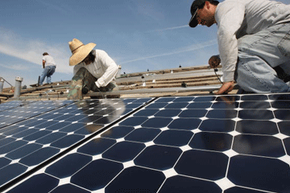
You've seen the dire warnings on the news about shrinking energy resources and increasing environmental problems. In your effort to become a better global citizen, you've installed solar panels on your roof. You're also being careful to turn off your lights and appliances when you leave for work each morning.
While you're away, your house is generating energy but you're not using it. Meanwhile at night, when you have the lights and TV blaring, your solar system is sitting idle. You could buy an expensive battery to store the extra energy you generate during the day, but there's another option that allows you to send your extra power to the grid in exchange for banked energy credit that you can use when you need it. It's called net metering.
When your home is equipped with a renewable energy source (such as wind or solar power), it sends the excess energy that's generated back into the grid to power other homes. An electrical converter called an inverter turns the DC (direct current) power coming from your renewable energy source into AC (alternating current) power, which matches the voltage of the electricity flowing through the power line.
As that excess energy is being generated, your power meter spins backward rather than forward, giving you a credit that you can use to pay for your future energy use (you can roll over excess electricity to your next bill, just as many cell phone companies let you roll over minutes).
If you've generated more energy than you've used at the end of the year, your electric company may pay you back for the extra power at the retail rate. If you have market-rate net metering, the utility company will pay only a wholesale rate, which is less than retail and won't earn you anything (it's kind of like giving away your extra energy), but you'll still save on your overall power bill.
Net metering can be measured over the month or year. Annualized net metering provides a more accurate measurement because it takes into account your changing energy usage and production over the four seasons.
 Net metering plugs the energy you make at home back into the grid.
Christopher Furlong/Getty Images
Net metering plugs the energy you make at home back into the grid.
Christopher Furlong/Getty ImagesThe most obvious benefit of net metering is to consumers. If you install net metering in your home, you can reduce the amount of money you spend each year on energy. You can even make money if you produce more than you consume and your utility company pays you for that excess energy at the retail rate.
Here are a few other benefits of net metering:
The amount of money homeowners can save with net metering depends on how much energy they produce. A 10-kilowatt residential wind energy system can save a consumer an estimated $10 to $40 a month [source: American Wind Energy Association].
Not everyone is sold on the idea of net metering, however. To the utility companies, the idea of consumers buying less power from them (and even having to pay consumers for the energy they produce) means shrinking profits. For that reason, they have opposed many proposed state legislations that would have made it easier for consumers to use net metering.
In the next section, you'll see which states have been successful in creating net metering regulations.
Under a federal law called the Public Utility Regulatory Policies Act (PURPA), utilities must allow homes that produce their own energy to connect to the energy grid; the companies must buy any excess power homes or businesses produce.
Forty-two states and the District of Columbia have gone beyond that to allow net metering. In 2007, the number of people in net metering programs increased by 45 percent, to 48,820. California has the largest number of net metering customers, with 72 percent of the national total [source: Energy Information Administration].
Although most states allow net metering, policies and requirements vary from state to state. An organization called Network for New Energy Choices has graded states on their net metering policies. They awarded top grades to states that provide incentives to homes and businesses that install renewable energy systems, provide credit for sending excess energy into the grid, and reduce bureaucracy (red tape and fees).
In their 2007 report, "Freeing the Grid," the organization gave top marks to states like Arizona, Illinois, Florida, Massachusetts, Oregon, Utah and Vermont. Massachusetts has one of the most progressive policies in the country, thanks to its 2008 Green Communities Act, which gives consumers incentives for installing solar and other renewable energy systems. However, 28 states earned Ds or Fs because their rules were so restrictive that they make it almost impossible for the average homeowner to participate.
Often legislation gets stalled because of resistance from the utility companies. In June 2007, Texas signed a bill into law that called for net metering to go into effect "as rapidly as possible" [source: Fast Company]. But when the utilities protested, legislators gave in and the law was compromised.
Do you know if your state allows net metering? Check out this map of net metering programs by state, or go to the next page and learn more.
Zero-energy HomesHow much energy does your home use in a year? If you owned a zero-energy home, you could honestly say, "none." Zero-energy homes use energy-efficient appliances and insulation to reduce their consumption, while producing their own energy with renewable power generating systems (such as solar or wind). When those homes are connected to the energy grid and use net metering, they can end up producing just as much energy as they consume.