The scale height (H) of the Earth's atmosphere refers to the vertical distance over which the density of the atmosphere decreases by a factor of 1/e (approximately 0.368), or about 36.8%. It provides a measure of how rapidly the atmospheric density decreases with altitude.
Effect of scale height on climate and weather patterns:
The scale height of the atmosphere plays a significant role in influencing climate and weather patterns:
1. Atmospheric Pressure and Density: The scale height determines how quickly atmospheric pressure and density decrease with altitude. Higher scale heights imply a slower decrease, resulting in higher pressure and density at higher altitudes. This variation in pressure and density affects air circulation, wind patterns, and weather phenomena.
2. Temperature Distribution: The scale height influences the vertical temperature distribution within the atmosphere. As altitude increases, the air becomes less dense, which allows for more efficient radiative cooling. This leads to the well-known temperature lapse rate, where temperature generally decreases with increasing altitude. The scale height determines the rate of this temperature decrease.
3. Hydrostatic Equilibrium: The scale height is directly related to the concept of hydrostatic equilibrium in the atmosphere. Hydrostatic equilibrium occurs when the weight (or pressure) of the air above a certain level is balanced by the upward force exerted by the air below. The scale height determines the vertical distribution of air mass that achieves this balance.
4. Atmospheric Stability: The scale height affects atmospheric stability, which refers to the tendency of an air parcel to return to its original position after being displaced vertically. A smaller scale height indicates a more stable atmosphere, where air parcels have less tendency to rise and generate convective activities. This can impact cloud formation and precipitation patterns.
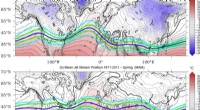
5. Global Circulation Patterns: The variations in atmospheric density and temperature with altitude, influenced by the scale height, drive global atmospheric circulation patterns. These circulation patterns, such as the Hadley Cells, Ferrel Cells, and Polar Cells, determine major wind and weather systems that affect regional and global climate.
6. Weather Phenomena: The scale height influences the formation and behavior of weather phenomena, including clouds, precipitation, and storms. For example, the height and density of cirrus clouds, which are composed of ice crystals, are influenced by the scale height of the upper atmosphere.
In summary, the scale height of the atmosphere plays a crucial role in shaping climate patterns, atmospheric circulation, temperature distribution, and the occurrence of various weather phenomena. Understanding the scale height is essential for studying and predicting weather patterns, climate variability, and the effects of human activities on the atmosphere.