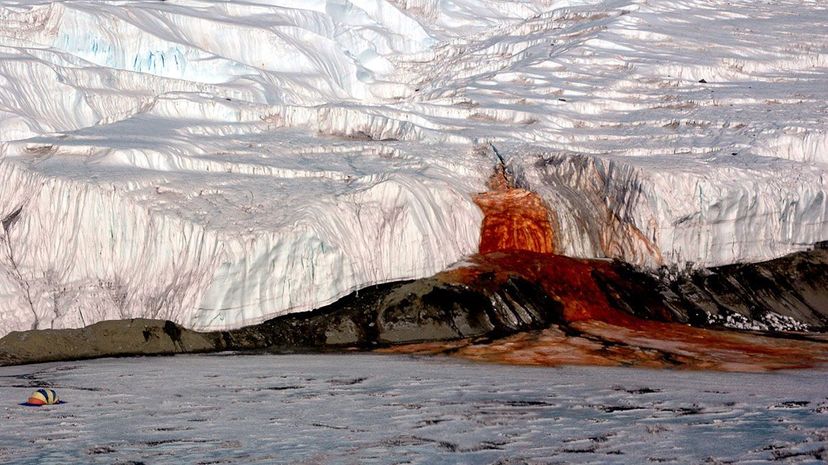
If you were to say that the blood-red color of an Antarctic waterfall was only the second most interesting thing about it, it might be hard to take you seriously. After all, one look at Blood Falls and you're probably pretty focused on the horrifying "Carrie" prom scene nestled in the ice of Taylor Glacier. You're not looking for much else to catch your eye. But while that horror scene hue undoubtedly pulls you in, scientists have now figured out the source of the pigmentation — and it's arguably more fascinating than the ghoulish falls itself.
When geologist and all-around adventurer Thomas Griffith discovered the geological wonder back in 1911, the prevailing idea was that a type of algae was causing the distinctive red bloom of water, sort of like the harmful algal blooms, or red tides, that have been known to plague Florida's Gulf Coast. However, a 2003 analysis found that it was actually high levels of iron — turned to rust in the water — that tinged the water so distinctively. But this presented another mystery: Scientists weren't sure where the salty, iron-laden liquid water was coming from that fed the waterfall.
After conducting radio-echo sounding (a technique that uses a radar signal to investigate the subsurface of glaciers), researchers found a subsurface lake complete with a flowing path of water that supplied the briny, iron-rich water to the falls. Second mystery solved!
This discovery is particularly interesting because it confirms that flowing water can persist inside a glacier as cold as Taylor, something researchers weren't sure was possible.
NOW THAT'S COOLHow the heck can liquid water exist in a clearly freezing glacier? It's actually the process of freezing that keeps it moving. As water freezes, it releases heat that can melt the ice around it. Add in some salty water that freezes at a lower temp, and you have flowing water in a glacier.