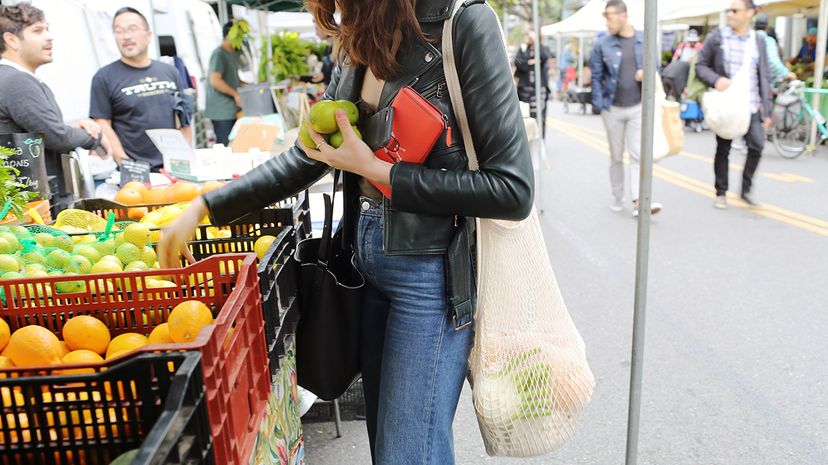
If you're already filling your recycling bin to the brim, if you never go anywhere without your reusable grocery totes, if you wouldn't touch a plastic water bottle with a 6-foot all-natural hiking pole, you might be ready to step up to the absolute pinnacle of green lifestyle.
We're talking "zero waste." As in no household waste.
Empty garbage cans. Every. Single. Week.
It can be done. It might take a little getting used to, of course, and a change in lifestyle, for sure. Plus, your idea of "zero" waste might not jibe with someone else's. In fact, your idea of "waste" might not fit with other people's definition.
But, yes, the notion that we can drastically cut back what we use and consume to such a level that it's at least pretty close to zero is utterly attainable, says Kathryn Kellogg, who runs a site called Going Zero Waste.
And the best part is that everybody will be better off the closer we get to zero.
"It's not about being perfect," Kellogg says. "It's just about trying to use your consumer voice to make change."
The idea of zero waste has been around for some time now. Many cite Bea Johnson's seminal 2013 book, "Zero Waste Home: The Ultimate Guide to Simplifying Your Life by Reducing Your Waste," for bringing the concept to the masses. Johnson, born in France and now living in California, blogs at Zero Waste Home and preaches the zero-waste gospel throughout the world.
She, along with people like Kellogg and New York's Lauren Singer (Trash is for Tossers) gladly show off months' worth of their household garbage — maybe a year or longer, even — that easily fits into a single glass jar. A small jar.
A year's worth of garbage in a jar? Many of us have more than that on our night tables.
What do you do with, say, paper towels or tissues or those bones from that store-bought chicken that you just bought that came in that big plastic bag that you now feel so guilty about?
Zero waste has to be darn near impossible. Doesn't it?
"Honestly, going zero waste is a bunch of tiny little changes that over time add up to a really big impact. If you think about it, bringing your bags to a grocery store isn't Earth-shattering," Kellogg says. "Asking for your coffee in a mug while you sit in the cafe, instead of [having it in] a disposable [cup] ... that's not like massively changing your life."
It's important to admit that the zero-waste movement — and, yes, it is definitely a movement — wouldn't be needed if we didn't produce staggering amounts of waste. According to the Environmental Protection Agency (EPA), the average American generates some 4.4 pounds (1.9 kilos) of trash that goes to a landfill every day. It's not just landfills, either. A patch of garbage floating in the Pacific Ocean between California and Hawaii is filled with tons and tons of plastic. It's now twice the size of Texas.
To stop producing all that garbage, Kellogg says, we can take some easy steps. The first three are EPA favorites. Some go further. You'll get the idea:
We can start our way to a zero-waste lifestyle by ourselves. But we may need some help — mainly from the people who produce all this stuff — if we're really going to make a dent in this garbage pile that's strangling the planet.
Kellogg talks about "rewriting the system" to "write waste out of existence" by people demanding that businesses and governments become more environmentally responsible. "Individuals must act so policies can react," she says. "Manufacturers really need to step up and say that this is something they want to do. I think we're seeing a lot of small businesses moving toward that model."
Until that happens on a much larger scale, though, it's up to us. Here are some practical everyday ways we can move toward the zen of zero.
 Swapping out your plastic storage containers for eco-friendly stainless steel is a great way to go zero waste. As long as you recycle the old ones.
trashisfortossers.com; packagefreeshop.com
Swapping out your plastic storage containers for eco-friendly stainless steel is a great way to go zero waste. As long as you recycle the old ones.
trashisfortossers.com; packagefreeshop.com
One 2017 study published in the journal Science Advances points out that 8.3 billion metric tons (9.1 billion tons) of plastic have been produced in the past 60 years or so, resulting in 6.3 billion metric tons (6.9 billion tons) of plastic waste. Only 9 percent of that has been recycled. That's a lot of plastic in landfills and seeping into the oceans.