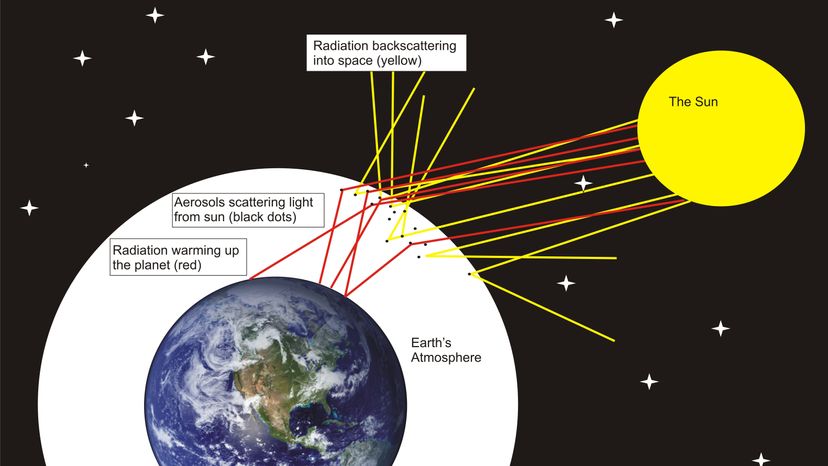
With nations in the industrialized world falling behind on their promises to reduce greenhouse gas emissions that are driving the planet toward a climate catastrophe, it's tempting to look at more radical measures that might at least provide more time for governments to get their act together. Various geoengineering solutions would attempt to slow global warming by altering the environment.
One geoengineering technique, stratospheric aerosol injection (SAI), would pump millions of tiny sulfate particles into the stratosphere, where they would reflect a fraction of sunlight back into space before it reaches the Earth. That essentially would simulate the sunlight-blocking effect of large volcanic eruptions such as the 2001 eruption of Mount Pinatubo in the Philippines, which pumped 15 million tons (13.6 million metric tons) of sulfur dioxide into the stratosphere — resulting in a global temperature drop of 1 degree Fahrenheit (0.5 degrees Celsius) that lasted for 15 months.
That might provide a breather in the planet's warming trend. But as described in this presentation from Rutgers University, some scientific critics have been warning for years that SAI could also have serious risks, including the possibility of causing disastrous droughts in Africa and Asia, and the danger of causing rapid warming if the regimen is stopped.
Another question about SAI is whether it's even feasible, given the scale of the operation that would be required. But a study, published in June 2018 in the journal Environmental Research Letters suggests that it might be done for a relatively modest cost of around $2.25 billion per year, provided that a new, purpose-built, high-altitude tanker aircraft — with a stubby, narrow fuselage to accommodate a molten sulfur payload, expansive wings and four engines — is developed and deployed.
"We don't make any judgment about the desirability of stratospheric aerosol injection," co-author Gernot Wagner, a research associate at Harvard's John A. Paulson School of Engineering and Applied Sciences and co-director of the university's Solar Geoengineering Research Program, said in a Harvard University press release, published Nov. 28, 2018. "But we do show that a hypothetical deployment program starting 15 years from now, while both highly uncertain and ambitious, would be technically possible from an engineering perspective."
Now That's InterestingIn order to accomplish SAI, the fleet of new, purpose-built, high-altitude tanker aircraft would have to be around 100 aircraft, and fly up to 60,000 missions a year, according to the Harvard University SEAS press release.
ScienceGreen ScienceHow Global Warming WorksScienceGreen ScienceIs global warming irreversible?ScienceGreen ScienceWhat would it take to reverse global warming?ScienceGreen ScienceHow will global warming affect autumn?ScienceGreen ScienceIs global warming destroying Mount Everest?ScienceGreen ScienceHow does global warming affect hunting season?ScienceGreen ScienceWhat does global warming have to do with the decline in the polaScienceGreen ScienceWhat will global warming do to the wine industry?ScienceNatural DisastersDid global warming cause Hurricane Sandy?ScienceGreen ScienceHow can adding iron to the oceans slow global warming?ScienceGreen Science10 Things That Donât Disprove Global WarmingScienceGreen ScienceWhat's the Difference Between Global Warming and Climate Change?ScienceGeophysicsCould Injecting Particles Into the Stratosphere Slow Global Warming?ScienceGreen ScienceCould reversing global warming start an ice age?ScienceGreen ScienceWhat Can I Do About Global Warming?ScienceGreen ScienceCould military strategy win the war on global warming?ScienceGreen ScienceHow Carbon Offsets WorkScienceGreen ScienceHow Carbon Tax WorksScienceGreen ScienceHow Carbon Footprints WorkHomeGarden DesignIf I plant trees in my yard, will it offset global warming?EntertainmentOlympicsHow Is Global Warming Affecting the Winter Olympics?