You may know that lakes and ponds and their related flora and fauna are important parts of Earth's biodiversity. Without them, numerous animals like birds, alligators, beavers, otters and snakes (just to name a few) would have no source of food or water, let alone a place to call home.
But did you know that some rivers, streams and creeks also need a feature called a riparian buffer? Even if you've never heard the term before, you've most likely seen one. Let's talk about exactly what riparian buffers are and why they're so important to protecting the environment.
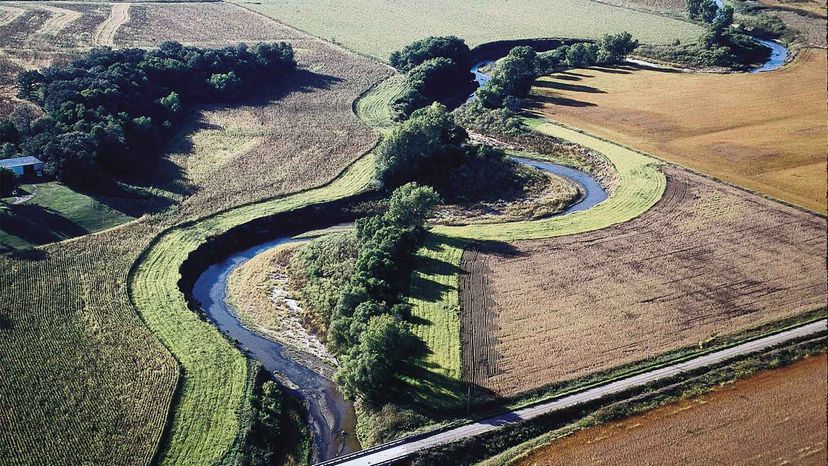
Riparian buffers act as a barrier — or buffer — between industrially altered land and natural waterways. They contain trees, shrubs and perennial plants, and are managed differently than the surrounding landscape to provide conservation benefits, according to the USDA National Agroforestry Center. They help shade and partially protect waterways from the impact of the adjoining urban, industrial or agricultural land use.
Unfortunately, modern farming, construction and other human activity contributes to increased soil erosion, and nutrient and chemical run-off, which causes loss of wildlife habitat. That's where riparian buffers come in. In a nutshell, they act as built-in, natural water filtering systems that safeguard the water quality, and provide a varied habitat for wildlife.
The USDA National Agroforestry Center also says the buffers, or riparian forests, have numerous benefits to the environment and landowners:
Historically, small fields were surrounded by fencerows — an uncultivated strip of land on each side of, and below, a fence. Most of these small fields weren't tilled and the existing vegetation and root systems created natural buffers above and below ground. Regular crop rotations also provided nutrients from organic matter.
Today, however, many of the buffers must be re-created by hand — riparian buffers. Each region of the United States implements its buffers according to geography, land use and conservation priorities. In the East, buffers are often used to decrease sediments flowing into streams and estuaries, while in the Midwest, they're generally used to stabilize stream banks, reduce pollutant runoff and restore habitat for fish and wildlife in heavily cultivated terrains.
In the Northwest, buffers are used primarily to restore and protect migratory fish habitat. In the Southwest, most buffers are created to improve habitat for at-risk marine and land species.
The National Agroforestry Center works with small farms to implement a three-zone buffer system like the one below that it developed to help restore local buffers.
 This graphic shows exactly how the National Agroforestry Center's three-zone buffer system works.
USDA
Now That's Interesting
This graphic shows exactly how the National Agroforestry Center's three-zone buffer system works.
USDA
Now That's InterestingThe USDA Forest Service notes that while riparian buffers are typically created for conservation efforts, they can also be designed to produce cash crops of native fruits and nuts, medicinals and floral trees and shrubs.