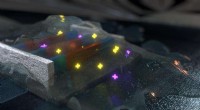
Here are a few examples of how the law of reflection is used in everyday life and science:
1. Mirrors: The law of reflection is essential for the working of mirrors. When you look into a mirror, you see your reflection because light rays from your face strike the mirror's surface and reflect back towards your eyes at the same angle. The image you see in the mirror is a mirror image, with left and right reversed, because the light rays are reflected off the mirror's surface.
2. Periscopes: Periscopes are devices that are used to see over or around obstacles. They consist of two mirrors arranged in a specific way. The light rays from the object being observed strike the first mirror and are then reflected off the second mirror towards the viewer's eyes. The law of reflection ensures that the light rays are reflected at the correct angles to allow the viewer to see the object clearly.
3. Prisms: Prisms are triangular pieces of glass or other transparent material that bend (refract) light rays when they pass through them. The law of reflection is used to understand how light rays interact with prisms and how they are refracted. Prisms are used in various optical devices, such as spectrometers and telescopes, to separate and analyze light into different wavelengths or colors.
4. Optical Fibers: Optical fibers are thin, flexible strands of glass or plastic that transmit light over long distances. The light rays are guided through the optical fiber by multiple internal reflections off the fiber's inner surface. The law of reflection ensures that the light rays stay within the optical fiber and are not lost due to absorption or scattering. Optical fibers are used in communication networks, medical imaging, and other applications.
5. Reflectors: Reflectors are devices that redirect light rays in a specific direction. They use the law of reflection to bounce light rays off a reflective surface and direct them towards the desired target. Reflectors are commonly used in headlights, flashlights, traffic signs, and other lighting applications.
These are just a few examples of how the law of reflection plays a crucial role in various aspects of everyday life and scientific applications.