Deep taproots: Trees develop deep taproots that extend several meters below the surface to access groundwater sources not readily available to shallow-rooted plants.
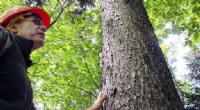
Thick bark: The bark of trees in arid environments is often thick and waxy, which helps reduce water loss through transpiration.
Small leaves or needles: Trees may have small leaves or needles that reduce the surface area exposed to the sun, thereby minimizing water loss through evaporation.
Leaf modifications: Some trees have leaves with a waxy coating or hairy surface that helps retain moisture.
Stomata control: Trees can control the opening and closing of stomata, the small pores on leaves that regulate gas exchange, to minimize water loss.
Water storage: Trees may store water in their trunks, stems, or leaves for use during dry periods.
Drought dormancy: In extreme conditions, trees may enter a state of drought dormancy, where they temporarily shut down non-essential processes to conserve water.
Leaf shedding: Some trees shed their leaves during dry periods to reduce water loss.
CAM (Crassulacean Acid Metabolism): Certain trees use CAM, a specialized form of photosynthesis, to open their stomata at night when water vapor pressure is higher, thus minimizing water loss.
These adaptations allow trees to survive and thrive in arid environments where water is scarce and competition for resources is intense.