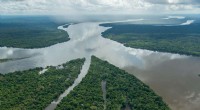
The scientists were able to identify the primary areas of the Arctic Continental Shelf where freshwater flowing from rivers causes acidification of the seawater and where it leads to the release of carbon dioxide into the atmosphere.
These are important advances since changes in the Arctic Ocean carbon cycle and acidification could have major implications for the Arctic ecosystem and global climate change.
Using more than 100,000 data measurements, collected during several field programs over the last 15 years, the team investigated the impact of freshwater and its associated dissolved inorganic carbon entering the coastal Arctic Ocean from many large rivers across northern North America, from the Mackenzie River in Canada, to the Colville and Yukon rivers in Alaska.
A key finding of their study was that when freshwater is lighter than the surrounding seawater, as is often the case in summer, the river water will flow on the surface of the ocean. This can reduce local ocean acidification and promote release of carbon dioxide to the atmosphere. Conversely, when freshwater is denser than the surrounding seawater, as is often the case in winter, the river water will flow along the bottom of the ocean. In this case, they found, freshwater can enter the Arctic Ocean and cause local acidification.
One of the more surprising results of the study, said co-author Vladimir Vladimirov, of UAF's International Arctic Research Center and School of Fisheries and Ocean Sciences, was the discovery that the Colville River in Alaska plays a much more important role in Arctic Ocean acidification than previously thought.
"The Colville River has very high rates of freshwater delivery, but previously it was thought that the shallow Mackenzie Shelf limited its impact on the ocean," he explained. "We now show that under certain circumstances, freshwater released into the southeastern Beaufort Sea from the Colville can be entrained onto the deeper Arctic Continental Shelf and then spread over hundreds of kilometers, having a measurable impact on entire ocean conditions of the western Arctic Ocean."
The results indicate that as sea ice continues to retreat and the amount of freshwater coming from large rivers increases in response to thawing permafrost and glaciers, localized acidification is expected to become more widespread on the Arctic Ocean shelves. This acidification could negatively affect marine life, such as shellfish, that are sensitive to changes in water chemistry.
"Overall, our results advance our predictive capabilities of Arctic Ocean acidification, an imperative to better understanding ocean-atmosphere carbon dioxide fluxes in a changing Arctic environment," said the study's lead author, Sarah Cooley of UAF's International Arctic Research Center and the University of Rhode Island's Graduate School of Oceanography.