The event — known as the Paleocene-Eocene Thermal Maximum, or PETM — released over 3 trillion tons of carbon into the atmosphere from volcanic activity or methane release from the sea floor.
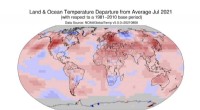
This caused the average global temperature to jump by 5 to 8 degrees Celsius (about 9 to 14 degrees Fahrenheit) over a period of about 20,000 years, wiping out a number of species and causing a major shift in the distribution of plants and animals.
This event shows how sensitive the Earth’s climate is to changes in the carbon cycle, and has implications for today's climate crisis, said Benjamin Burger of the University of Arizona, lead author of a paper describing the findings published in the journal Science.
“We knew that the PETM was a big deal, but what we found was that it was even bigger than we thought. This is the most significant release of carbon over the last 66 million years, and it caused the biggest temperature increase,” he said.
The research team analyzed fossil leaves collected from Tanzania, Ellesmere Island, Canada and New Mexico. They used advanced techniques to estimate the levels of carbon dioxide in the atmosphere at the time the leaves were formed.
The results showed that the atmospheric carbon dioxide concentration during the PETM was about 2,500 parts per million (ppm) compared with a preindustrial concentration of about 280 ppm.
The rapid increase in carbon dioxide caused a major increase in plant growth, which in turn led to a cooling effect on the climate, Burger said. “The plants sucked all of that extra carbon out of the atmosphere, which is what stabilized the temperatures.”
The research team also found evidence of a mass extinction of certain types of plants during the PETM. This, they believe, was caused by a combination of the rapid temperature increase and the shift in the distribution of plant species.
“I want people to think about what happens when you pump a huge amount of carbon into the atmosphere very rapidly,” Burger said. “It causes the Earth’s climate system to change very rapidly, and that can have catastrophic effects.”