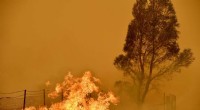
1. Biomass burning: Biomass burning, primarily from agricultural practices and forest fires, releases particulate matter, carbon monoxide, nitrogen oxides, and other pollutants into the atmosphere. These pollutants can be transported over long distances by prevailing winds and contribute to regional air pollution over the Indian Ocean.
2. Industrial emissions: Industrial activities, such as power plants, manufacturing facilities, and refineries, emit pollutants like sulfur dioxide, nitrogen oxides, and volatile organic compounds (VOCs). These emissions can contribute to the formation of smog and particulate matter, leading to poor air quality over the Indian Ocean.
3. Ship emissions: Shipping activities emit pollutants such as sulfur oxides, nitrogen oxides, and particulate matter from the combustion of marine fuels. These emissions are particularly concentrated along major shipping routes and can impact air quality over the Indian Ocean.
4. Natural sources: Natural sources, such as volcanic eruptions, dust storms, and wildfires, can also contribute to air pollution over the Indian Ocean. Volcanic eruptions release large amounts of ash and sulfur dioxide, while dust storms transport dust particles and contribute to particulate matter concentrations.
5. Meteorological conditions: Meteorological conditions, such as wind patterns, atmospheric stability, and precipitation, play a significant role in the dispersion and transport of air pollutants. Certain weather conditions can trap pollutants near the surface, leading to higher air pollution levels, while others can facilitate dispersion and reduce pollutant concentrations.
6. Long-range transport: Air pollutants can be transported over long distances by prevailing winds, leading to transboundary air pollution over the Indian Ocean. Pollutants emitted in one region can be transported to another, contributing to regional air pollution issues.
7. Climate change: Climate change can influence air pollution over the Indian Ocean by altering weather patterns, temperature gradients, and precipitation. Changes in these factors can affect the formation, transport, and dispersion of air pollutants, leading to variations in air quality over time.
Understanding and managing the various factors influencing air pollution over the Indian Ocean is crucial for developing effective strategies to improve air quality and protect human health and the environment.