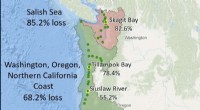
While coastal habitat restoration can indeed provide a number of benefits, including carbon sequestration, it is important to be realistic about the potential of these ecosystems to offset carbon emissions on a large scale.
Here are a few reasons why we can't rely on regrowing coastal habitats to offset carbon emissions:
1. The rate of habitat restoration is slow.
Coastal habitats can take decades or even centuries to fully recover after being damaged or destroyed. This means that the carbon sequestration benefits of habitat restoration will not be realized for a long time. In the meantime, carbon emissions continue to rise, making it difficult to achieve climate stabilization.
2. The carbon sequestration potential of coastal habitats is limited.
While coastal habitats can store large amounts of carbon, the total amount of carbon that can be sequestered by these ecosystems is finite. Once a habitat reaches its carbon storage capacity, it will no longer be able to sequester additional carbon.
3. Coastal habitats are vulnerable to climate change impacts.
Coastal habitats are already facing a number of threats from climate change, including sea level rise, coastal erosion, and ocean acidification. These threats are expected to intensify in the future, which could damage or destroy coastal habitats and release their stored carbon back into the atmosphere.
4. Habitat restoration is not always feasible.
In some cases, it may not be possible to restore coastal habitats due to physical constraints, such as lack of space or suitable substrate. In other cases, the cost of habitat restoration may be prohibitive.
Given these limitations, it is clear that we cannot rely on coastal habitat restoration alone to offset carbon emissions. While habitat restoration can provide a valuable contribution to climate change mitigation, it must be combined with other strategies, such as reducing fossil fuel emissions, improving energy efficiency, and investing in renewable energy.