Abstract:
This study investigates how climate change alters the severity of combined wind-rain extremes over the UK and Ireland, key drivers of socio-economic impacts. Using convection-permitting regional climate model simulations, we analyze changes in spatiotemporal characteristics of these events, including gust speed, precipitation intensity, and their joint occurrences.
Results indicate a substantial increase in the recurrence rate of future combined wind-rain events, with a more pronounced rise during the cool season. Spatial patterns reveal a poleward shift in the primary occurrence region, particularly for severe events, with Ireland and Northern Ireland becoming more susceptible. Changes in vertical thermodynamic structure and circulation patterns play key roles in these modifications.
The findings highlight the compounding effects of climate change on wind-rain extremes, suggesting an increased likelihood of infrastructure damage and societal disruption in vulnerable regions.
Introduction:
Extreme weather events, such as strong winds and heavy precipitation, can have severe impacts on infrastructure, ecosystems, and human lives. Climate change is projected to alter the frequency, intensity, and spatial distribution of these extremes, potentially leading to increased socio-economic losses.
Combined wind-rain extremes, characterized by the simultaneous occurrence of strong winds and heavy precipitation, pose significant hazards due to their ability to cause widespread damage and disruption. Understanding how these events may change in a warming climate is crucial for developing effective adaptation and mitigation strategies.
Methods:
We utilize high-resolution convection-permitting regional climate model simulations from the Met Office Unified Model to investigate future changes in combined wind-rain extremes over the UK and Ireland. The simulations are driven by two representative concentration pathways (RCPs): RCP2.6, representing a moderate emissions scenario, and RCP8.5, representing a high emissions scenario.
We analyze various metrics, including gust speed, precipitation intensity, and the joint occurrence of extreme wind and rain events. Changes in atmospheric dynamics and thermodynamic conditions are also examined to understand the physical drivers behind the projected alterations.
Results:
Our results show a substantial increase in the frequency of combined wind-rain extreme events over the UK and Ireland in both the RCP2.6 and RCP8.5 scenarios. The rise is more pronounced during the cool season (October to March) compared to the warm season (April to September).
In terms of spatial distribution, the primary occurrence region of these events shifts poleward under both emissions scenarios. Ireland and Northern Ireland, which currently experience relatively lower frequencies of combined wind-rain extremes, are projected to witness a significant increase in their occurrence rates.
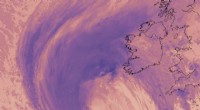
The changes in event frequency are closely linked to alterations in atmospheric circulation patterns, with the increased frequency and strength of deep low-pressure systems and ascending air masses playing a crucial role.
Discussion:
The findings of this study highlight the amplifying effect of climate change on the severity of combined wind-rain extremes over the UK and Ireland. The projected increase in the recurrence rate of these events, particularly in vulnerable regions, poses significant challenges for disaster risk management and adaptation planning.
Understanding these changes and their underlying mechanisms is essential for developing mitigation and adaptation strategies to reduce the potential impacts on infrastructure, ecosystems, and human communities.