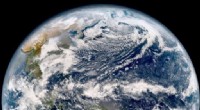
It would be more proper to ask, "What is the mass of Earth?" The quick answer to that is approximately 6,000,000,000,000,000,000,000,000 (6 x 1024) kilograms.
The interesting sub-question is, "How did anyone figure that out?" It's not like the planet steps onto the scale each morning before it takes a shower. The measurement of the planet's weight is derived from the gravitational attraction that the Earth has for objects near it.
ContentsIt turns out that any two masses have a gravitational attraction for one another — literally any two in the solar system. If you put two bowling balls near each other, they will attract one another gravitationally. The attraction is extremely slight, but if your instruments are sensitive enough you can measure the gravitational attraction that two bowling balls have on one another.
From that measurement, you could determine the mass of the two objects. The same is true for two golf balls, but the attraction is even slighter because the amount of gravitational force depends on the mass of the objects.
Isaac Newton showed that, for spherical objects, you can make the simplifying assumption that all of the object's mass is concentrated at the center of the sphere. In the case of our planet, the center of the sphere would be Earth's center.
The following equation expresses the gravitational attraction that two spherical objects have on one another:
F = G(M1 x M2/R2)
Assume that Earth is one of the masses (M1) and a 1-kg sphere is the other (M2). The force between them is 9.8 kg x m/s2 — we can calculate this force by dropping the 1-kilogram sphere and measuring the acceleration that the Earth's gravitational field applies to it (9.8 m/s2).
The radius of the Earth is 6,400,000 meters (6,999,125 yards). If you plug all of these values in and solve for M1, you find that the mass of the Earth is 6,000,000,000, 000,000,000,000,000 kilograms (6 x 1024 kilograms, or 1.3 x 1025 pounds).
Why is it "more proper" to ask about the Earth's mass rather than weight? Weight is a force that requires a gravitational field to determine. You can take a bowling ball and weigh it on the Earth and on the moon. The weight on the moon will be one-sixth that on the Earth, but the amount of mass is the same in both places.
To weigh the Earth, we would need to know in which object's gravitational field we want to calculate the weight. The mass of the Earth, on the other hand, is a constant.