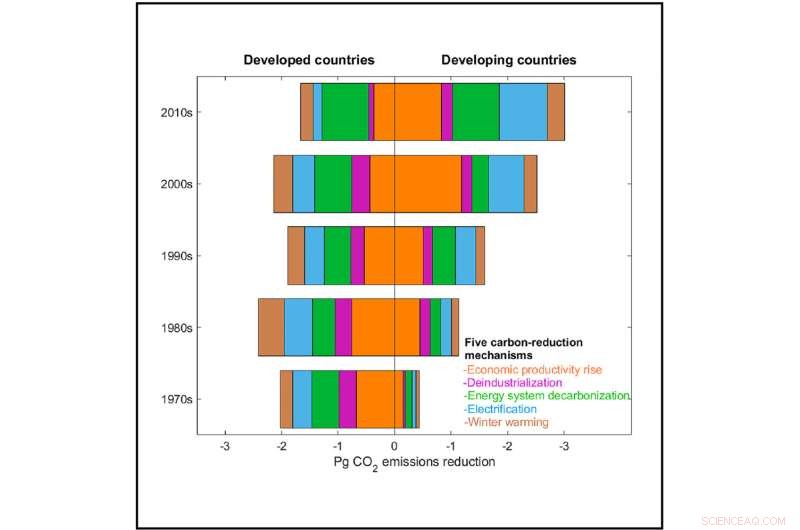
Graphical abstract. Credit: DOI: 10.1016/j.oneear.2021.10.010
Fearing a trade-off with economic growth, countries feel discouraged to cut their CO2 emissions. But do the two really not go together? Environmental scientist Ranran Wang and her colleagues investigated the relationship between economic growth and CO2 emissions in 73 countries from 1970 to 2016. Wang: "We also identified mechanisms by which countries drove down their CO2 emissions, especially during economic growth."
Five CO2-reducing mechanisms
Fearing a trade-off with economic growth, countries feel discouraged to cut their CO2 emissions. But do the two really not go together? Environmental scientist Ranran Wang and her colleagues investigated the relationship between economic growth and CO2 emissions in 73 countries from 1970 to 2016. Wang: "We also identified mechanisms by which countries drove down their CO2 emissions, especially during economic growth."
What and how? The five mechanisms explained
Increased productivity key role in emission reduction
In developing countries, the most important reduction factor was an increase in economic productivity. "Increased productivity has been widely recognized as a fundamental driver of economic growth," says Valentina Assevona, assistant professor at the Wharton School, University of Pennsylvania. "Now our findings reveal that it also plays an important role in reducing CO2 emissions. It explains around 47 percent of the total emission reduction that developing countries achieved during the 2000s."
In developed countries, energy decarbonisation was the dominant reduction mechanism. Since the 1970s, they have put more and more effort into sustainable, low carbon energy.
Growth must not be based on carbon
The findings can help underpin robust strategies for mitigating CO2 emissions. Edgar Hertwich, professor at the Norweigan University of Science and Technology: "Our research underlines that the effect of public policy on economic structure is indeed relevant for the climate. That's something that is yet often not recognized."
"As long as economic growth is based on fossil energy, it will keep increasing our emissions," Hertwich says. "So, that's where we can make our greatest gains. It is crucial that we first move away from fossil fuels and electrify. Leading European countries have already shown that decarbonisation can go hand-in-hand with economic growth. However, we need to strengthen this effort substantially to reach the Paris climate target. We hope our research can contribute to that."