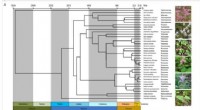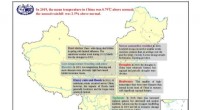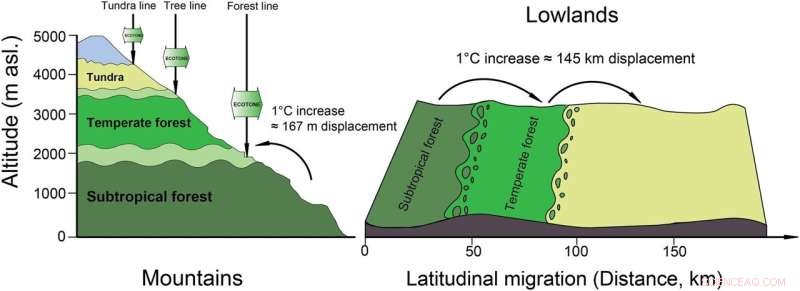
The replacement of vegetation zone toward to high-altitudes. It is about 167m lift in the vertical dimension when the temperature increases 1°C. Accordingly, vegetation redistribution and species migration will take place. Note that the altitudes of the three representative vegetation zones, that is, subtropical forest, temperate forest, and alpine tundra are according to the references (Colwell et al., 2008; Díaz-Varela et al., 2010; Jump et al., 2009; Körner, 2005). Credit: Earth's Future (2022). DOI: 10.1029/2021EF002566
Climate change and human activities have already caused degradation in a large area of vegetation on the Qinghai-Tibetan Plateau (QTP).
The influences of human activities on ecological system particularly on alpine grassland and alpine meadow have been accelerating and intensifying in recent decades. However, it remains unclear how human activities (mainly livestock grazing) regulates vegetation dynamics under climate change.
Now, a research team from the Northwest Institute of Eco-Environment and Resources of the Chinese Academy of Sciences examined the dual effects of climate change and human activities by correlation analyses of data from 87 meteorological stations and economic statistical data of the QTP.
Related results were published in Earth's Future on May 6.
The researchers analyzed the dynamic changes of vegetation belts on the QTP as well as the sensitivity of the QTP to climate change.
Results showed that the vegetation in central and southwestern QTP with high altitudes was improving due to warm-humid climate trend. Increase in temperature and reduction in the harsh frigid climate at high altitudes due to global warming resulted in expansions of the vegetated areas.
In addition, the researchers found that the degraded areas were mainly confined to the northern and eastern QTP, which had high human and livestock population densities.
In comparison to gently changing climate regimes, anthropogenic activities such as chronic concentration of population and livestock in the valleys with less harsh climate, exerts a much stronger pressure on vegetation.
The study indicates that the anthropogenic pressure is much more intensive than the impact of climate change and is critical for the conservation and sustainable management of the QTP vegetation, especially for realizing the UN 2030 SDGs on alpine regions.