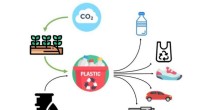
Credit: Wikimedia commons and Water-Science-Policy
Certain sources of chemical pollution of the aquatic environment, such as agriculture or municipal wastewater, are now reasonably well known. But knowledge of the quantities and diversity of synthetic organic compounds released in industrial wastewater from chemical and pharmaceutical production remains fragmentary. This is not unproblematic, as the substances in question include compounds which are highly persistent, bioaccumulative or may promote the development of antibiotic resistance. In addition, many substances slip through the net of conventional monitoring since they are simply not targeted.
Non-registered chemicals also found
In this nationwide study published in Water Research, effluents from 11 wastewater treatment plants (WWTPs) were investigated in detail over a period of several months. At the WWTPs selected, discharges from industry made up a widely varying proportion of the wastewater treated—from 0 to 100%. Effluent samples were analyzed using (partly automated) high-resolution mass spectrometry. It was thus possible to determine the total number of compounds present and also to monitor substances for which only short-term peaks were detected. The findings of this extensive sampling campaign were essentially threefold: