Historians trace the first use of asphalt all the way back to 625 B.C., where a king's procession used it as a road building material. Today, in the U.S. alone, the national highway system includes approximately 160,000 miles (257,495 kilometers) of roadway [source: U.S. DOT]. That number doesn't even take into account local streets, roads and parking lots.
Next time it rains, take a moment to look outside at your street or parking lot. Do you see how the rainwater tends to pool up near the curb and run toward the sewer? During heavy storms, you can see and even hear floods of water rushing into that sewer, taking everything in its path. We call this runoff. Runoff not only contributes to flooding and erosion; it also plays a part in the contamination of our water supply.
Runoff occurs because traditional pavement is nonporous -- meaning it doesn't allow rainwater to settle back into the ground. Green pavement, a relatively new concept in green building, is a permeable and porous pavement (try saying that three times fast) that absorbs rainwater instead of repelling it. It allows water to return to the ground, which means the water doesn't wash into the sewer, along with oil, gas and pesticide residue. Called green pavement because of its environmental advantages, besides protecting our water supply, many green pavement products contain recycled materials.
Is green pavement actually green? Nope. Most permeable pavement is gray or beige in color, although some companies have developed a load-bearing grass turf that is strong enough even for a helicopter landing pad [source: Netlon]. Green pavement is a viable alternative for footpaths, driveways and parking lots, and one day it could revolutionize highway systems.
So, what's the difference between green pavement and asphalt or concrete? Read on to find out.
Building Your Own Green DrivewayAre you a do-it-yourselfer with a green thumb? With the proper tools and know-how, you can make your own green driveway for around $1,200. First, grade the site and install a catch basin for drainage. Dig a bed and fill it with crushed gravel. Buy some plastic grass pavers (recycled, of course) and lay them down on your driveway base. Fill the pavers with concrete sand. Compact the pavers carefully and then roll down some sod and irrigate. In a few weeks, you'll have a grassy area strong enough to hold the weight of your car [source: HGTV].
Contents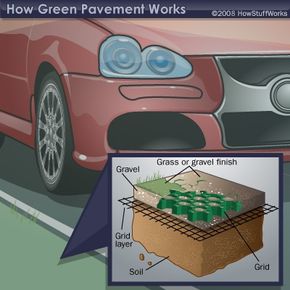
Green pavement is catchall name for a few different types of environmentally friendly pavements and vehicle surfaces suited for different contexts, such as hot climates, high-speed traffic areas and less-traversed areas.
When people talk about green pavement, they are usually referring to permeable pavement. Unlike traditional asphalt or concrete, permeable pavement is porous; it allows water to run through it rather than pool on top or run off of it. Water percolates, as in a coffee pot, when it seeps through the pavement to a cleansing layer of gravel. The gravel or stone acts as a natural filter, clearing the water of pollutants. There are three types of permeable pavements:
When installed as part of an overall system, permeable pavement can even eliminate the need for curb gutters and storm sewers [source: Green Resource Center]. Flooding concerns lessen, as rainwater soaks into the ground.
Permeable pavement has many applications. Common uses include driveways, emergency access lanes, public parks, alleys, parking lots and bike or walking paths. Today's green pavement typically does not have enough load-bearing strength to maintain highway traffic, but new breakthroughs in building materials could make that a possibility in the future. A few porous asphalt highways are in use in the United States and Europe [source: Georgia Asphalt Pavement Association].
Grass pavers (a type of plastic paver) are a very popular landscaping and building choice, as they perform the duty of pavement, but look like grass. There are many different grass paver products on the market (Grasspave2, Geoblock, Tuff Track, Grassy Paver, Grass-Cel, Checker Block and Grasscrete, for example), and all have their own pros and cons [source: Invisible Structures Inc.]. What they all have in common is that they allow grass to grow even in high-traffic areas. Grass pavers come in interlocking grid or honeycomb shapes. Once installed, grass or other vegetation can grow in the spaces of the grid. The result is a load-bearing grassy area. Some can support over 97,000 pounds (43,998 kilograms) per square foot [source: Grassy Pavers].
Next up, we'll take a look at some of the benefits and drawbacks of green pavement.
Chicago's Green Alley InitiativeThe city of Chicago has an extensive system of alleys, designed to lessen congestion on main streets. These alleys mostly host an array of garages, trash bins and dumpsters. Prone to flooding, they contribute to an already-taxed city sewer system. In 2007, however, the city implemented its Green Alley Initiative. Alleys were (and continue to be) retrofitted with permeable pavement, which will lessen flooding and send water back into the ground in an environmentally safe manner.
Designed to reflect heat rather than absorb it, the permeable pavement can also lower temperatures in the immediate area. In addition to installing this new pavement, the city of Chicago is encouraging homeowners to plant rainwater gardens and bioswales (shallow ditches filled with plants) that help absorb and filter water [source: Green Alley Handbook].
The White Sox also installed the largest permeable pavement parking lot in the country. U.S. Cellular Field is the first Major League sports facility to use permeable pavement [source: Medill Reports].
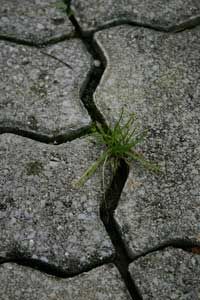
The pavement and asphalt industry has been around since the 1800s. In fact, Edmund J. DeSmedt, a Belgian chemist, laid the first true asphalt pavement in the United States in 1870 -- in Newark, N.J. With advances such as the automobile and air travel, pavement became, and continues to be, one of the largest U.S. industries [source: NAPA].
However, traditional asphalt and concrete pavements have a few disadvantages. As we've already mentioned, because these materials are nonporous (or impervious), rainwater cannot seep into them and instead runs off. As the water travels, it may also collect oil, gasoline and other pollutants as it washes into neighboring streams and rivers. This runoff can cause steady landscape erosion.
Additionally, traditional asphalt gets very hot, creating a "heat island" effect in urban environments. A heat island is exactly what it sounds like -- an area that is much warmer than its surroundings. (You can learn more about this phenomenon in What is the urban heat island effect?) Many manufacturers believe green pavement can change all that. We've already talked about green pavement's superior storm runoff management, but what else does it do for the environment?
Now that we've addressed the green pavement pros, let's take a look at the cons.
How do LEED and green pavement link?The Leadership in Energy and Environmental Design (LEED) Green Building Rating System is the national benchmark for the design and construction of high-performing, environmentally-friendly buildings. An independent party verifies that the building meets the LEED standards, which include:
Certified buildings receive a LEED plaque. A LEED-certified building also qualifies for tax rebates, zoning allowances and many other incentives, which makes the certification valuable to builders. Builders who include green pavement in their projects can receive LEED credits for storm water control, heat island effect, water-efficient landscaping and recycled content [source: U.S. Green Building Council].
While green pavement has promise, it also has several significant drawbacks.
For one thing, pavers can pose a problem for snowplows. Because pavers are not a smooth surface -- pavers can be a plastic honeycomb shape or concrete blocks with spaces in between -- a plow blade can catch on the edge of the plastic or block and rip it up. One way to resolve this problem is to install a roller on the plow blade, which allows the blade to roll over any uneven portions of the pavement.
Porous/permeable pavement is more expensive to install than traditional pavement. Proponents point out, however, that the need for less drainage piping and other storm water management materials can offset that extra expense.
Permeable pavement is also prone to clogging. Its maintenance demands are different from traditional pavement. If not maintained properly (with an industrial vacuum), sand and other fine sediments can block the spaces between pavers. To prevent this problem, the pavement needs to be vacuumed or pressure-washed at least twice a year. (Obviously, if it were used for public roads, governments would have to come up with equipment and manpower to handle its special maintenance requirements.) Sanding for ice during the winter months can contribute to clogging. If left unchecked, clogging will cause storm water and other pollutants to run off, negating the purpose of the installation [sources: Metropolitan Area Planning Council and Stormwater].
In addition, porous pavement isn't as strong as traditional pavement. Consistent pressure, such as heavy vehicle braking, can collapse the pores of the pavement, causing it to fail. Therefore, the pavement is not advised for things like airport runways or highways (especially those with heavy truck traffic). Currently, it is recommended only for flat areas or those with gentle slopes, where constant high-pressure braking is not an issue [source: Government of Nashville]. However, more reinforced versions of permeable pavement are in development.
To learn more about green pavement and other green trends, read the links on the next page.
Green Highways PartnershipThe (GHP) grew out of the Federal Highway Administration's (FHWA) efforts to "green" the U.S. highway system. Its goal is to integrate transportation functionality with ecological sustainability. In addition to porous pavements, the GHP calls for the following improvements to our current system:
The GHP currently encompasses only the mid-Atlantic states of Delaware, the District of Columbia, Maryland, Pennsylvania, Virginia and West Virginia. However, the organization hopes to one day grow the GHP into a national certified program [source: GHP].
Sources