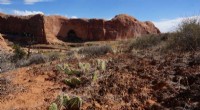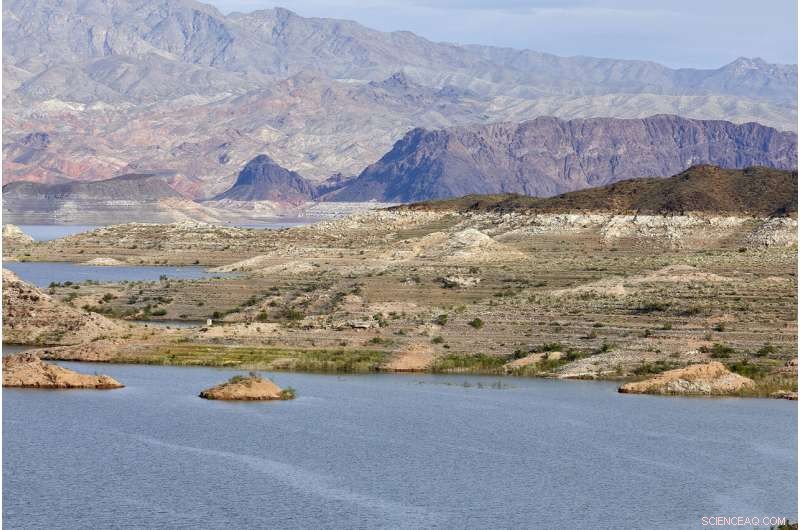
Lake Mead. Credit: Josh Hawkins/UNLV
As the climate crisis continues to affect the American West, sunken boats and human remains aren't the only surprises to be revealed by record-low water levels at Lake Mead. Sedimentary rocks that hadn't been seen since the 1930s are now exposed along the constantly changing shoreline, and a UNLV study of the deposits has discovered that many of these rocks also contain ash from volcanoes as far away as Idaho, Wyoming, and California that rained down on Southern Nevada as many as 12 million years ago.
While metropolises located directly in the lava-flow path of active volcanoes tend to receive high attention, the UNLV College of Sciences' Cryptotephra Laboratory for Archaeological and Geological Research (CLAGR) team says explosive volcanic eruptions can have just as critical an impact on the health and safety of populations far from the source.
"Ash from even moderately explosive eruptions can travel hundreds of miles from the source, blanketing entire areas with anywhere from a centimeter to several meters of the heavy material," said Eugene Smith, a UNLV emeritus professor of geology who specializes in volcanology, geochemistry, and geologic mapping and has worked on projects in Africa, Asia, North America, Europe, and Antarctica.
"Although the Las Vegas Valley is currently very far away from any active volcanoes, we can and will have ash from these volcanoes fall over Southern Nevada in the future," Smith said. "Even a couple of millimeters of ash, when wet, is incredibly heavy and can take down power and telecommunications lines. It can block roadways. It is easily remobilized by wind and water. When inhaled, the incredibly tiny but sharp glass grains in the ash can cause significant, chronic lung conditions such as silicosis."
Takeaways
CLAGR researchers used geologic mapping to locate and collect samples of multiple ash layers at Lake Mead and from outcrops just south of Henderson. Back in the lab, the samples were chemically analyzed and then compared to ashes from known volcanic eruptions across the western U.S. to help determine their age and location origin. Among their findings:
Volcanic ash can contain volcanic glass (think of the pumice stones people use to get rid of particularly stubborn foot calluses, but shrunken to almost microscopic size), debris, and crystals from the magma chamber that feeds the eruption. Depending on the size and force of the eruption, the ash, or tephra as geologists call it, can travel hundreds or even thousands of kilometers from the volcano.
One of the most famous examples of volcanic activity in the U.S. was the catastrophic 1980 blast at Mount St. Helens in Washington, which leveled forests, dammed up Spirit Lake, and deposited ash over several states—yet was considered a minor explosive eruption. Larger eruptions that deposit ash farther away can be hazardous to infrastructure such as powerlines, roads, railroads, and buildings, even multiple states away from the volcano itself, the UNLV research team said.
"Studying the past can help you plan for the future," said CLAGR lab manager and longtime Southern Nevada geologist Racheal Johnsen. "The ash layers we study come from volcanoes long extinct. However, studying them has helped us determine just how often the Las Vegas area was inundated with ash over time and may help us prepare for future events from active volcanoes far from us." + Explore further