By Scott Damon, Updated Aug 30, 2022
NIKITA GINDEA/iStock/GettyImages
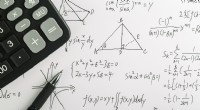
Geometry is the study of shapes that occupy space. When solving geometric problems, we distinguish between known information (givens) and unknowns that we must determine. It is possible to calculate the area of a triangle when only one side length is provided, provided that the two adjacent interior angles are also known.
Given one side and two interior angles, first compute a third side using the Law of Sines, then apply the area formula ½ × b × c × sin(A).
In the sample problem, side B is 10 units, and angles A and B are each 50°. Since the sum of interior angles in any triangle is 180°, the third angle C is found by subtracting the known angles from 180°:
Angle A + Angle B + Angle C = 180°
50° + 50° + Angle C = 180°
Angle C = 180° – 100° = 80°.
The Law of Sines states:
a / sin A = b / sin B = c / sin C
Here, the lowercase letters represent side lengths and the uppercase letters represent the corresponding interior angles. We can solve for the unknown side c opposite angle C using the known side b = 10 units and angles B = 50° and C = 80°:
c = (b · sin C) / sin B
Substituting the known values gives:
c = (10 · sin 80°) / sin 50° ≈ 12.86 units.
Once two side lengths are known, the area can be found with the formula:
Area = ½ × b × c × sin A
Using b = 10 units, c ≈ 12.86 units, and A = 50°:
Area = 0.5 × 10 × 12.86 × sin 50° ≈ 49.26 square units.
Thus, a triangle with one side of 10 units and adjacent angles of 50° and 80° has an area of approximately 49.26 square units.