By Joan Reinbold, Updated Aug 30, 2022
Walter Geiersperger/Corbis Documentary/GettyImages
Geologists and rockhounds worldwide recognize agates as distinctive chalcedony varieties marked by translucence, banding, and striking color patterns. These gems occur globally, with thousands of unique types catalogued by color and pattern. In the United States, several regions produce agates that are prized both for their beauty and for use as gemstones.
Agate is a term for certain translucent, cryptocrystalline quartz varieties that have served as ornamental stones for millennia. Quartz—one of the Earth’s most abundant minerals—exists in two primary forms: crystalline quartz, which forms visible crystals such as amethyst or rose quartz, and cryptocrystalline quartz, also known as chalcedony, whose constituent crystals are too fine to be seen without magnification.
Chalcedony is defined by its color and pattern. Agates are essentially chalcedony that contains mineral inclusions and impurities, creating unique banding and color combinations. When cut and polished, these patterns become unmistakable, allowing thousands of agate varieties to be distinguished worldwide.
While there are countless agate types, some of the most popular include onyx, eye agate, moss agate, dendritic agate, fire agate, and agatized petrified wood.
Onyx is a banded agate featuring alternating white bands with black, brown, or red. Eye agate, or ring agate, displays concentric rings that resemble eyes when polished.
Moss agate shows green mineral inclusions arranged in plant‑like patterns, while dendritic agate contains iron or manganese branches that grow in a tree‑like fashion.
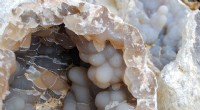
In the American Southwest—primarily Arizona—fire agate forms in botryoidal, grape‑shaped masses with iridescent rainbow patterns. Fire agate’s thin, alternating layers of iron oxides and silica make polishing challenging but rewarding.
Agatized petrified wood is one of the most valuable commercial gemstones and is also found in Arizona. The Petrified Forest National Park hosts some of the world’s most colorful agatized logs.
Agates thrive in any region that has experienced volcanic activity, with coastal areas and lakes offering excellent prospecting spots. In the United States, Oregon, Washington, Idaho, and Montana are prime agate locations. The Southwest and West, including Arizona, California, Colorado, and Utah, also yield exceptional agates, jaspers, and agatized fossils. Always verify local regulations before collecting, as rockhounding is not permitted everywhere.
Start by selecting a site known for agate discoveries. Study photographs of the specific agate type you seek to familiarize yourself with its hallmark features.
Key indicators of an agate include banding, a waxy or glossy surface, eye‑like spots, translucence, or distinctive color patterns. Lightweight, hollow stones may be agate geodes. Most agates are the size of a large nut or smaller, forming in cavities within volcanic rock.
In heavily visited areas, surface rocks may already be collected, so digging can reveal hidden specimens that have lain dormant for centuries.
Polishing or tumbling brings out an agate’s true colors and patterns. A simple test—immersing the stone in water—can reveal translucence and hidden hues before you invest in a full polish.
Agates and other chalcedony varieties are ideal for rock tumbling because they endure the process’s mechanical stresses and polish into stunning, mirror‑smooth finishes.
When selecting stones for tumbling, avoid cracked or hollow specimens. Choose stones of similar size and composition to ensure an even, high‑quality finish.