Here's why:
* Mantle plumes are columns of hot, buoyant rock that rise from deep within the Earth's mantle. They carry heat and material from the mantle towards the surface.
* The lithosphere is the rigid outer layer of the Earth, comprising the crust and the uppermost part of the mantle.
* Weaknesses in the lithosphere can be caused by:
* Pre-existing plate boundaries: These are areas where plates are moving apart (divergent boundaries) or colliding (convergent boundaries). These boundaries are naturally weaker than the rest of the lithosphere.
* Hot spots: These are areas where mantle plumes have repeatedly pierced the lithosphere over long periods, creating areas of localized weakness.
* Fractures and faults: These can be caused by tectonic stress or past volcanic activity.
When a mantle plume encounters a weakness in the lithosphere, the hot material from the plume can more easily penetrate the surface, leading to the formation of:
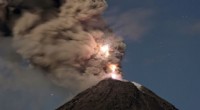
* Volcanoes: These form when molten rock from the plume erupts at the surface.
* Flood basalts: These are large, widespread volcanic eruptions that occur when the plume erupts through a large fissure.
* Mid-ocean ridges: These are underwater mountain ranges formed by the upwelling of mantle material at divergent plate boundaries.
In summary, the presence of a weakness in the lithosphere allows mantle plumes to reach the surface, leading to various geological phenomena like volcanic activity and the creation of new crust.