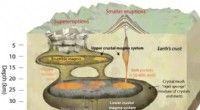
Caldera: This is the most common feature formed after a volcanic collapse. Calderas are large, circular depressions that form when the summit of a volcano collapses into the empty magma chamber below. They can be several kilometers wide and hundreds of meters deep. Famous examples include Crater Lake in Oregon, USA, and Yellowstone National Park in Wyoming, USA.
Crater: A crater is a smaller depression formed by the eruption of a volcano. It can also form after a smaller collapse of the volcano's cone.
Fissure: A fissure is a long crack that can form in the side of a volcano during an eruption or collapse. It can allow lava or ash to escape from the volcano.
Lava flow: When a volcano collapses, it can release lava from the magma chamber below. This lava can flow down the volcano's sides and create new features, such as lava domes or lava plateaus.
Pyroclastic flows: These are fast-moving flows of hot gas, ash, and rock fragments that can be released during a volcanic collapse. They can travel at speeds of hundreds of kilometers per hour and are extremely destructive.
Landslide: In some cases, a volcanic collapse can be triggered by a landslide. This can happen when the volcano's slopes become unstable due to erosion or earthquakes.
The exact features formed after a volcanic collapse depend on a number of factors, including the size and type of volcano, the amount of magma in the chamber, and the nature of the collapse.