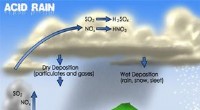
Rainwater as a Weak Acid:
* Carbon Dioxide (CO2) in the Atmosphere: Rainwater is slightly acidic because it absorbs carbon dioxide from the atmosphere. This creates carbonic acid (H2CO3).
* Weak Acid: Carbonic acid is a weak acid, meaning it doesn't completely ionize in water. However, it's still acidic enough to react with some minerals.
Dissolving Limestone:
* Limestone Composition: Limestone is primarily composed of calcium carbonate (CaCO3).
* Chemical Reaction: When rainwater (with carbonic acid) comes into contact with limestone, a chemical reaction occurs. The carbonic acid reacts with calcium carbonate, forming calcium bicarbonate (Ca(HCO3)2), which is soluble in water. This reaction can be represented as:
CaCO3 (limestone) + H2CO3 (carbonic acid) → Ca(HCO3)2 (calcium bicarbonate)
Cave Formation:
* Dissolution and Erosion: As rainwater flows over limestone, the chemical reaction described above causes the limestone to dissolve. Over time, this process creates cracks, crevices, and eventually, larger cavities.
* Underground Rivers: In some areas, rainwater may flow underground, following these cracks and dissolving the limestone from within. This can form complex cave systems with intricate formations like stalactites and stalagmites.
In Summary:
Rainwater is naturally slightly acidic due to dissolved carbon dioxide. This weak acidity reacts with limestone, causing it to dissolve. Over long periods, this dissolution process creates the caves we see today.