Here's how volcanoes form:
* Plate tectonics: The Earth's outer layer, the lithosphere, is divided into plates that move slowly. At divergent boundaries, where plates pull apart, magma rises from the mantle and erupts, forming volcanoes. This is how mid-ocean ridges and volcanic islands form.
* Convergent boundaries: At convergent boundaries, where plates collide, one plate can be subducted (forced) under the other. As the subducting plate descends, it melts, producing magma that rises to the surface and erupts as volcanoes. This is how volcanic arcs (like the Andes Mountains) and island chains (like the Aleutian Islands) form.
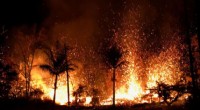
* Hot spots: These are areas within the Earth's mantle where unusually hot magma rises to the surface. As the plate moves over the hot spot, a chain of volcanoes can form. Hawaii is a classic example of a hot spot volcano.
Weathering, erosion, and deposition play a role in shaping the landscape around volcanoes, but they don't create the volcanoes themselves.
* Weathering breaks down volcanic rock into smaller pieces.
* Erosion moves these pieces away from the volcano by wind, water, or ice.
* Deposition is the process of these eroded materials settling in new locations, forming features like volcanic soils or alluvial fans.