Landslides:
* Rapid movement: Landslides involve the rapid downward and outward movement of soil, rock, or debris. This movement is often triggered by gravity and can occur very quickly, sometimes within seconds.
* Mass movement: Unlike erosion, which is a gradual process, landslides involve the movement of a large mass of material as a single unit.
* Triggering events: Landslides are often triggered by specific events such as heavy rainfall, earthquakes, volcanic eruptions, or human activities like deforestation and construction.
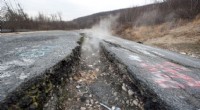
* Distinct features: Landslides leave behind characteristic features such as scarps (exposed cliffs), debris flows, and talus slopes.
Erosion:
* Gradual process: Erosion is the gradual wearing away and transportation of soil, rock, and other materials by natural forces like wind, water, and ice.
* Continuous process: Erosion is a continuous process that occurs over long periods.
* Transportation of material: Erosion involves the transportation of eroded material from one location to another, unlike landslides which primarily focus on movement down a slope.
* Variety of agents: Erosion can be caused by a variety of agents, including water (rivers, waves), wind (sand dunes, dust storms), and ice (glaciers).
Deposition:
* Opposite of erosion: Deposition is the process where eroded material is dropped or settled in a new location.
* Formation of landforms: Deposition plays a crucial role in the formation of landforms, such as deltas, alluvial fans, and sandbars.
* Controlled by energy: The amount of material deposited is influenced by the energy of the transporting force.
* Relationship with erosion: Deposition is closely linked to erosion, as the material deposited is often the result of previous erosion.
Key Differences:
* Speed: Landslides are rapid, while erosion is gradual.
* Mass movement: Landslides involve the movement of a large mass, while erosion involves the removal of smaller particles.
* Triggering events: Landslides are often triggered by specific events, while erosion is a continuous process.
* Resulting landforms: Landslides create distinct features, while erosion and deposition can form a variety of landforms.
In summary, landslides are rapid, gravity-driven mass movements that are triggered by specific events, while erosion is a gradual process of wearing away and transporting material, and deposition is the process of dropping or settling that material in a new location.