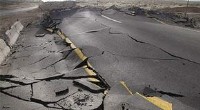
1. Tensional Stress: The Earth's tectonic plates move apart, creating tensional stress in the lithosphere (the rigid outer layer of the Earth). This stress stretches and thins the crust.
2. Fault Formation: As the tension increases, the crust eventually breaks along faults, which are fractures in the rock. These faults can be normal faults (where the hanging wall block slides down relative to the footwall block) or reverse faults (where the hanging wall block slides up relative to the footwall block).
3. Block Movement: The blocks of crust on either side of the fault move in opposite directions. In the case of fault block mountains, normal faults are the primary drivers. The hanging wall block drops down, creating a valley, while the footwall block is uplifted to form a mountain.
4. Mountain Formation: The process continues as the blocks continue to move along the faults. Over time, the uplifted blocks become fault block mountains.
Here are some key features of fault block mountains:
* Steep slopes: The uplifted blocks often have steep slopes, created by the fault scarp (the exposed face of the fault).
* Flat tops: The tops of the mountains are often relatively flat, as they were originally part of a horizontal layer of rock.
* Graben and Horsts: Fault block mountains are often found in groups, where the uplifted blocks are called horsts and the sunken blocks are called grabens.
Examples of fault block mountains:
* Sierra Nevada Mountains: (California, USA)
* Wasatch Range: (Utah, USA)
* Harz Mountains: (Germany)
* Vosges Mountains: (France)
Fault block mountains are a fascinating example of how the Earth's tectonic forces can sculpt the landscape, creating dramatic and distinctive geological features.