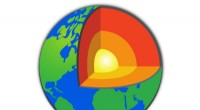
1. Crust:
* Thickness: 5-70 km (3-44 miles)
* Composition: Primarily composed of igneous, sedimentary, and metamorphic rocks. It's the thinnest layer and is divided into oceanic crust (denser, thinner) and continental crust (less dense, thicker).
* Characteristics: Relatively cool and rigid.
2. Mantle:
* Thickness: 2,900 km (1,800 miles)
* Composition: Mostly made of silicate minerals like olivine and pyroxene.
* Characteristics: Hot and dense, with temperatures increasing with depth. The mantle is divided into:
* Upper Mantle: Includes the lithosphere (rigid, outer layer) and the asthenosphere (semi-molten, weaker layer).
* Lower Mantle: More rigid and denser than the upper mantle.
3. Outer Core:
* Thickness: 2,200 km (1,400 miles)
* Composition: Liquid iron and nickel, with trace amounts of other elements.
* Characteristics: Extremely hot (around 4,500°C/8,132°F). The movement of the liquid metal generates Earth's magnetic field.
4. Inner Core:
* Radius: 1,220 km (758 miles)
* Composition: Solid iron and nickel.
* Characteristics: Extremely hot (around 5,200°C/9,392°F) and immense pressure, which keeps it solid despite the high temperature.
Key Features:
* Lithosphere: The rigid, outermost layer composed of the crust and the uppermost part of the mantle. It's broken into tectonic plates that move on the asthenosphere.
* Asthenosphere: A semi-molten, weaker layer within the upper mantle where convection currents occur.
* Convection Currents: Heat from the Earth's core drives these currents within the mantle, which are responsible for plate tectonics.
Exploring the Interior:
* Seismic Waves: Scientists study earthquakes and their seismic waves (P-waves and S-waves) to learn about the Earth's internal structure.
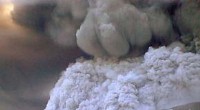
* Volcanoes: Volcanic eruptions bring up material from the mantle, providing clues to its composition.
* Meteorites: Some meteorites are thought to be similar in composition to Earth's core.
Understanding the Earth's internal structure helps us comprehend processes like plate tectonics, earthquakes, and volcanic activity. It also provides insights into the Earth's history and evolution.