What are Fault Lines?
Fault lines are fractures in the Earth's crust where rocks have moved past each other. These movements can be sudden and violent, causing earthquakes, or slow and gradual, resulting in the formation of mountains and valleys over millions of years.
Tectonic Plate Movement at Fault Lines:
The Earth's crust is made up of giant, moving pieces called tectonic plates. These plates constantly interact at their boundaries, which are often marked by fault lines. The way tectonic plates move at fault lines determines the type of fault and the geological features that result:
1. Divergent Plate Boundaries:
* Movement: Plates move apart from each other.
* Fault Type: Normal faults where the hanging wall (rock above the fault) slides down relative to the footwall (rock below the fault).
* Features: Formation of mid-ocean ridges, rift valleys, volcanoes, and new ocean crust.
2. Convergent Plate Boundaries:
* Movement: Plates move towards each other.
* Fault Type: Reverse faults where the hanging wall moves up relative to the footwall.
* Features: Formation of mountains, volcanic arcs, and deep ocean trenches.
3. Transform Plate Boundaries:
* Movement: Plates slide past each other horizontally.
* Fault Type: Strike-slip faults where the rocks move horizontally along the fault plane.
* Features: Formation of earthquakes, offsetting landforms, and linear valleys.
Examples of Fault Lines:
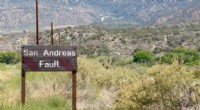
* San Andreas Fault (California): A transform plate boundary where the Pacific Plate slides past the North American Plate.
* Mid-Atlantic Ridge: A divergent plate boundary where the North American and Eurasian Plates are pulling apart.
* Himalayan Mountains: A convergent plate boundary where the Indian Plate is colliding with the Eurasian Plate.
Summary:
Fault lines are crucial for understanding the dynamic nature of the Earth's crust and the processes that shape our planet. The way tectonic plates move at fault lines determines the type of fault and the geological features that result. Understanding fault lines is essential for predicting earthquakes and mitigating their risks.