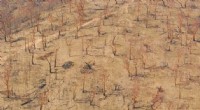
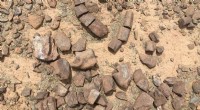
1. Weathering: This is the process of breaking down rocks into smaller pieces.
* Physical Weathering: Breaks down rocks into smaller pieces without changing their chemical composition.
* Frost wedging: Water freezes in cracks, expands, and widens the cracks.
* Thermal stress: Rapid temperature changes cause expansion and contraction, leading to fracturing.
* Abrasion: Rocks rubbing against each other, like in a river or glacier.
* Chemical Weathering: Alters the chemical composition of rocks.
* Oxidation: Iron in rocks reacts with oxygen, creating rust and weakening the rock.
* Acid rain: Rainwater with dissolved acids reacts with rocks, dissolving some minerals.
* Hydrolysis: Water reacts with minerals in rocks, changing their composition.
2. Erosion: This is the process of moving weathered rock fragments from one place to another.
* Wind: Can carry sand and dust, eroding rocks and shaping landscapes.
* Water: Rivers, oceans, and rain can carry sediment, carving valleys and canyons.
* Glaciers: Can carve valleys and transport large boulders, leaving behind glacial deposits.
* Gravity: Can cause landslides and rockfalls.
3. Deposition: This is the process of dropping off eroded rock fragments.
* Rivers: Deposited sediment forms floodplains and deltas.
* Oceans: Deposited sediment forms beaches and ocean floors.
* Glaciers: Deposited sediment forms moraines and glacial till.
4. Compaction and Cementation: These processes transform loose sediment into sedimentary rocks.
* Compaction: The weight of overlying sediments squeezes out water and air from the sediment.
* Cementation: Dissolved minerals in groundwater precipitate between sediment grains, binding them together.
5. Metamorphism: This is the process of changing existing rocks due to heat and pressure.
* Heat: Can cause minerals to recrystallize and change their structure.
* Pressure: Can cause rocks to deform and change shape.
* Fluids: Can carry dissolved minerals that react with existing minerals.
6. Magmatism: This is the process of melting rocks and forming magma.
* Heat: From Earth's interior or from friction caused by plate movement.
* Pressure: Can melt rocks at lower temperatures.
7. Igneous Rock Formation: When magma cools and solidifies, it forms igneous rocks.
* Intrusive igneous rocks: Formed from magma that cools slowly beneath the Earth's surface.
* Extrusive igneous rocks: Formed from lava that cools quickly on the Earth's surface.
The Rock Cycle is a continuous process:
* Sedimentary rocks: Can be weathered and eroded, creating new sediment.
* Igneous rocks: Can be weathered and eroded, creating sediment.
* Metamorphic rocks: Can be weathered and eroded, creating sediment.
* Sediment: Can be compacted and cemented to form sedimentary rocks.
* Sediment: Can be heated and pressured to form metamorphic rocks.
* Metamorphic rocks: Can be melted to form magma.
* Magma: Can cool and solidify to form igneous rocks.
So, rocks are constantly changing, being transformed from one type to another through the rock cycle.