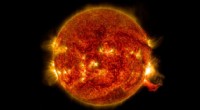
A Fiery Beginning:
* Molten and volatile: Earth formed around 4.5 billion years ago from the accretion of dust and gas in a swirling protoplanetary disk. This process generated immense heat, leaving the early Earth a molten ball of rock.
* No oceans, no atmosphere: There was no liquid water and the atmosphere was a thin, toxic mix of gases like hydrogen, helium, methane, and ammonia.
Early Evolution:
* The Hadean Eon (4.5-4.0 billion years ago): This was a period of intense volcanic activity and meteorite bombardment. The Earth was still too hot for liquid water to exist on the surface.
* The Archean Eon (4.0-2.5 billion years ago): As Earth cooled, water vapor condensed, forming the first oceans. The first continents began to form, and life arose in the oceans.
* The Proterozoic Eon (2.5 billion years ago - 541 million years ago): Life diversified, with the appearance of single-celled organisms, and later multicellular life. Oxygen levels in the atmosphere began to rise.
Key Features:
* No life as we know it: The earliest life forms were simple, single-celled organisms. Complex life, including plants and animals, didn't appear until much later.
* A hostile environment: The early Earth was a harsh place with frequent volcanic eruptions, meteor impacts, and intense UV radiation.
* Continents in motion: Plate tectonics, the movement of Earth's crust, was already active, shaping continents and oceans.
Understanding the Reflection:
Reflecting on the early Earth helps us understand:
* The origins of life: How life arose from non-living matter in such extreme conditions is a fundamental question in science.
* The formation of our planet: Studying the early Earth helps us understand the processes that shaped our planet and its unique environment.
* The evolution of life: Understanding the early stages of life helps us understand how life evolved over billions of years to produce the diversity we see today.
Key Takeaway: The early Earth was a very different world from the one we know today. It was a fiery, volatile place where life first arose and evolved. Studying its reflection helps us understand the history of our planet and the origins of life itself.