Rotation (spinning on its axis):
* Day and Night: The Earth's rotation on its axis causes the cycle of day and night. As the Earth turns, different parts of the planet face the sun, experiencing daylight, while other parts face away, experiencing night.
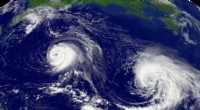
* Coriolis Effect: The Earth's rotation causes a deflection of moving objects, like wind and ocean currents. This effect is responsible for the clockwise rotation of storms in the Southern Hemisphere and counterclockwise rotation in the Northern Hemisphere.
* Tidal Forces: Although the sun also exerts tidal forces, the moon's gravitational pull is stronger due to its proximity. The Earth's rotation interacts with this pull to create tides, which rise and fall twice a day.
* Precession of the Equinoxes: Over thousands of years, the Earth's rotational axis slowly wobbles like a spinning top. This wobble, known as precession, causes the equinoxes (the days when day and night are equal in length) to shift slowly over time.
Revolution (orbiting around the sun):
* Seasons: The Earth's tilted axis combined with its revolution around the sun causes the seasons. As the Earth orbits the sun, different hemispheres are tilted towards or away from the sun, resulting in varying amounts of sunlight and temperature.
* Year: The Earth's revolution around the sun defines a year, which is approximately 365.25 days.
* Solar and Lunar Eclipses: The Earth's position relative to the sun and moon during its revolution is responsible for solar and lunar eclipses. Solar eclipses occur when the moon passes between the Earth and the sun, while lunar eclipses occur when the Earth passes between the moon and the sun.
* Earth's Orbit Variations: The Earth's orbit isn't perfectly circular but slightly elliptical. These variations in distance from the sun influence the intensity of solar radiation and contribute to long-term climate cycles.
These are just some of the major phenomena resulting from the Earth's rotation and revolution. These fundamental movements are crucial for life on Earth, shaping our weather, climate, and the very nature of our days and years.