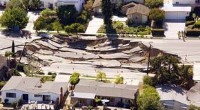
1. Faults and Fault Scarps:
* Faults: These are fractures in the Earth's crust where rocks have moved past each other. They are the primary cause of earthquakes.
* Fault Scarps: These are cliffs or steep slopes that form along fault lines. They represent the vertical displacement of land during earthquakes.
2. Folded Mountains:
* Earthquakes often occur along convergent plate boundaries where tectonic plates collide. This pressure can fold the Earth's crust, creating mountain ranges like the Himalayas.
3. Trenches:
* Deep, narrow depressions in the ocean floor form where one tectonic plate subducts beneath another. These trenches are often associated with earthquakes and volcanic activity.
4. Volcanic Landforms:
* Earthquakes can trigger volcanic eruptions, leading to the formation of various landforms:
* Volcanoes: Conical mountains formed by the accumulation of lava and ash.
* Calderas: Large, bowl-shaped depressions formed by the collapse of a volcano after an eruption.
* Lava Flows: Streams of molten rock that solidify as they flow.
5. Uplifts and Subsidence:
* Earthquakes can cause localized areas of the Earth's crust to rise (uplift) or sink (subsidence).
* Uplifts: These can form hills, plateaus, or even new islands.
* Subsidence: This can create depressions, basins, or sinkholes.
6. Landslides and Rockfalls:
* Earthquakes can destabilize slopes, leading to landslides, rockfalls, and other forms of mass wasting.
7. Coastal Features:
* Earthquakes can cause significant changes in coastal landscapes:
* Tsunamis: Giant waves generated by earthquakes beneath the ocean floor.
* Coastal Subsidence: This can lead to flooding and the loss of coastline.
8. Hot Springs and Geysers:
* Earthquakes can increase the flow of groundwater, leading to the formation of hot springs and geysers.
It's important to remember that the specific landforms found in an earthquake zone depend on the type of fault, the magnitude of the earthquakes, and the surrounding geology.